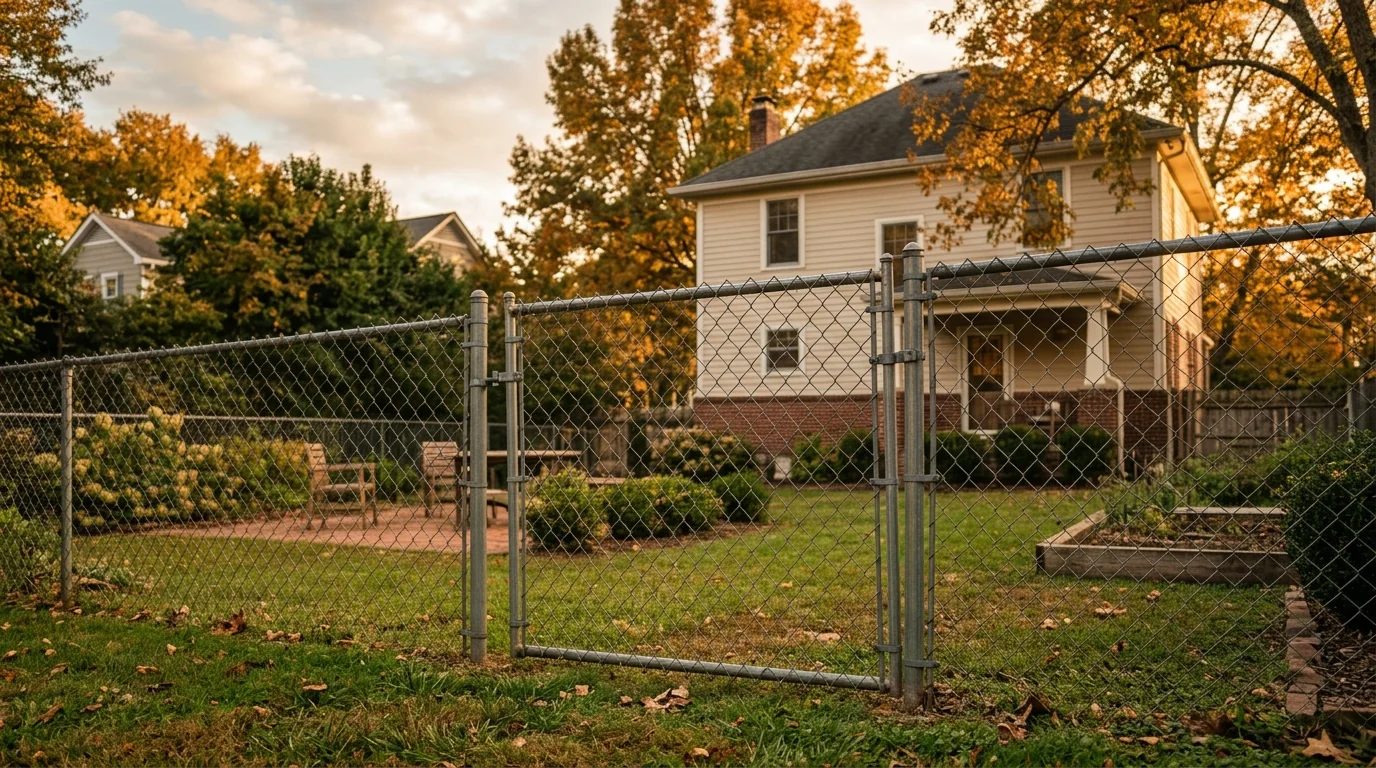
What is chain link fence installation and when is it the right choice?
Chain link fence installation is the process of setting galvanized or vinyl-coated steel posts in concrete footings and stretching a woven steel mesh between them to create a durable, low-maintenance perimeter. For Knoxville homeowners who need reliable pet containment, a property boundary along a rear or side yard, or a utility enclosure around HVAC equipment, chain link delivers more fence per dollar than any other material on the market. It is not the choice for privacy, and it is not the choice for front-yard curb appeal in West Knox HOA communities. But when the job is purely functional and budget matters, nothing matches its installed cost-to-durability ratio in Knox County conditions.
How it works mechanically
Terminal posts (corner posts, end posts, and gate posts) anchor the system. They are set in concrete at 30 to 36 inches deep and are larger in diameter than the line posts that run between them. Once the concrete cures, a top rail threads through post caps and acts as the structural spine of the fence. The mesh is then unrolled along the length, attached to terminal posts with tension bands and tension bars, and pulled tight with a come-along tool until the weave is taut and the fence stands plumb. Bottom tension wire or a bottom rail keeps the mesh from lifting near grade.
Conditions chain link is designed for
Chain link performs exceptionally well in Knox County’s moderate-to-high shrink-swell clay soils because the flexible mesh accommodates minor post movement without cracking or splitting. It also handles ice loading better than many homeowners expect: the open weave lets sleet and freezing rain pass through rather than accumulate as a solid sheet. That matters in Knoxville winters, where ice storms are a documented cause of fence damage, particularly to solid-panel wood fences and fences with overgrown vegetation woven into them. Chain link is also resistant to the wood-destroying insects and fungal rot that Knox County’s 47.9 inches of average annual rainfall (NWS Morristown KMRX, 1991-2020 Climate Normals) creates for untreated or improperly finished wood.
Conditions where an alternative is better
Chain link is the wrong answer when privacy is the primary goal. Roughly 45 to 50 percent of homeowners buying fences nationwide cite privacy as their top motivation, and chain link provides none. For those buyers, wood privacy fence installation in Knoxville is the more appropriate starting point. Chain link is also a poor match for front yards in Farragut and other West Knox HOA communities, where design standards often prohibit it explicitly. If your goal is curb appeal, property value recovery, or matching the aesthetic of a newer West Knoxville subdivision, wood or vinyl will serve you better.
Installation process
Chain link fence installation follows a predictable sequence. Understanding each step helps you know what to expect on the job site and what questions to ask before work begins.
Step 1: Site layout and marking (Day 1 morning, 1-2 hours)
The installer marks post locations with spray paint or flags, spacing line posts 10 feet apart as a standard interval. Terminal post locations at corners, ends, and gate openings are staked first. Tennessee law requires utility locates before any digging; confirm your contractor calls 811 before the crew arrives.
Step 2: Post hole augering (Day 1 morning-afternoon, 2-4 hours depending on lot size)
A gas-powered or skid-steer-mounted auger bores holes 30 to 36 inches deep for line posts and deeper for terminal posts, which carry higher load. Knox County’s residual limestone clay is generally cooperable with standard auger bits, but ridge-position lots with shallow bedrock may require a rock auger attachment, which slows production and may add to cost. Average Knoxville residential projects cover roughly 155 linear feet, which means 15 to 17 line post holes plus terminal and gate posts.
Step 3: Post setting and concrete pour (Day 1 afternoon, 1-2 hours)
Posts are dropped into holes, plumbed with a level, and braced temporarily. Fast-setting concrete is poured dry into the hole and wetted, or premixed concrete is poured and screeded. Terminal posts typically receive more concrete volume than line posts given the tension loads they carry. Concrete must cure 24 to 48 hours before mesh tension is applied.
Step 4: Top rail installation (Day 2 morning, 1-2 hours)
Once posts are set, the installer threads the top rail through loop caps on each line post and secures it to terminal post caps with rail ends and bolts. This rail is the structural spine; a crooked or low-spec rail produces a fence that sags over time.
Step 5: Mesh unrolling and tensioning (Day 2 morning-afternoon, 2-4 hours)
The mesh roll is stood on end at one terminal post, attached with tension bands and a tension bar, and walked along the fence line. At the opposite terminal post, a come-along tool pulls the mesh until the weave is taut and the fence stands without bulging. Tie wires secure mesh to line posts and the top rail at regular intervals. A bottom tension wire or bottom rail is installed last to prevent the mesh from lifting along the ground line.
Step 6: Gate hanging and final inspection (Day 2 afternoon, 1 hour)
Gate frames are assembled or delivered pre-assembled, hung on gate posts with offset hinges, and adjusted for swing clearance and latch alignment. For pool enclosures, gates must be self-closing and self-latching per CPSC Safety Barrier Guidelines for Residential Pools, which specifies a minimum barrier height of 48 inches above grade on the exterior face.
Chain link fence installation vs. wood privacy fence installation
Both methods use the same basic post-setting approach: augered holes, concrete footings, surface-mounted rails. The differences emerge above grade, and those differences drive most of the cost and performance gap between the two.
Chain link is faster to install and easier to inspect. A crew can tension and tie mesh in a fraction of the time it takes to fasten individual boards to a wood fence of the same length. That labor savings translates directly to lower installed cost. Bob Vila’s fence installation cost guide puts chain link at $15 to $30 per linear foot installed, compared to $27 to $60 per linear foot for wood privacy fencing.
Wood wins on privacy and aesthetics, full stop. A 6-foot board-on-board cedar or pressure-treated pine fence blocks sightlines completely, which is what most Knoxville families with children and dogs actually want. Chain link does not. Vinyl-coated chain link in black or green reads less industrial than bare galvanized mesh, but it still does not provide privacy.
Maintenance is where chain link holds a long-term advantage in Knoxville. Pressure-treated Southern Yellow Pine, the standard residential wood material in Knox County, requires staining or sealing every two to four years to resist the moisture and humidity that 47.9 inches of annual rain produces. Chain link needs almost no maintenance beyond a periodic inspection for rust at cut ends and loose tension wire along the bottom. For a rental property, a dog run, or a rear boundary along a wooded lot, that difference in ongoing cost matters more than the aesthetic gap.
The honest edge case for wood is resale value and HOA compliance. In Farragut, Hardin Valley, Northshore, and other West Knox planned communities, chain link is commonly restricted or prohibited in front yards and sometimes rear yards as well. If your property sits inside one of these communities, wood or aluminum ornamental fencing is likely your only compliant option. Check your HOA covenants and the Town of Farragut’s design standards before getting quotes for either material.
Chain link fence installation cost in Knoxville, TN
According to Bob Vila’s fence installation cost guide, chain link fence installation runs $15 to $30 per linear foot nationally. At Knoxville’s average residential project size of roughly 155 linear feet, that puts a typical perimeter project between $2,325 and $4,650 before gates and local variables are factored in. HomeAdvisor’s fencing cost estimator places chain link projects in a total range of $1,100 to $2,700 for smaller yards, with per-foot figures ranging from $5 to $40 depending on gauge, coating, and height.
Several local variables move the number up or down for Knox County projects.
Fence height. Standard residential chain link runs 4 to 6 feet tall. A 6-foot fence uses more mesh and taller posts than a 4-foot fence, adding material cost per linear foot.
Mesh gauge and coating. Standard 11-gauge galvanized mesh is the least expensive option. Stepping up to 9-gauge or adding a vinyl coating adds $2 to $5 per linear foot but improves durability and appearance in Knox County’s higher-pH limestone soils.
Terrain and access. Sloped lots in Knox County’s Valley and Ridge terrain require the installer to rack the fence (stepping or racking the mesh to follow grade) or step the fence in sections. Both approaches add labor. Lots where equipment cannot reach, such as rear yards with narrow side-yard access, may require hand-digging some post holes.
Number of gates. Each gate adds $150 to $400 depending on width, style, and whether it needs a locking mechanism or pool-compliant self-latching hardware.
Rock augering. Ridge-position lots with shallow bedrock require a specialty bit. If rock is encountered, expect an added cost per post.
For a detailed look at what drives the final number on your property, see the chain link fence installation cost breakdown for Knoxville.
Warranty and transferability
A quality chain link installation should carry a minimum 15-year warranty on the galvanized framework. Vinyl coating warranties are shorter, typically five years, because UV exposure in Tennessee summers degrades the coating faster than the underlying steel. When reviewing a warranty, ask three questions: whether it covers the posts and concrete footings in addition to the mesh and hardware, whether it transfers to a new owner if you sell the property, and what the contractor’s process is for honoring a warranty claim.
The American Fence Association’s industry standards provide a benchmark for installation quality. AFA-member contractors commit to those standards, which is a useful filter when comparing quotes.
Post-setting quality is the single largest predictor of fence longevity in Knox County. A fence with shallow footings in expansive clay will heave and lean within a few freeze-thaw cycles regardless of what the warranty says. Before signing, ask the installer what depth they set posts to and whether they adjust for terminal vs. line post load differences.
Permits and engineering in Knoxville
Permit requirements for chain link fencing in the Knoxville metro depend on which jurisdiction your property falls under.
City of Knoxville. A permit is required for any fence over 6 feet tall and for fences in certain overlay or historic districts. Contact City of Knoxville Plans Review and Inspections before work begins. Fees typically run $40 to $90.
Town of Farragut. Farragut maintains stricter fence permitting and design review requirements than either the city or the county. Even a standard 4-foot chain link fence may require design approval. Contact Farragut Community Development before finalizing your plans.
Unincorporated Knox County. Knox County Codes Administration and Inspections requires permits for fences over 6 feet tall. Below that threshold, no permit is required in most unincorporated areas, but property setback rules still apply.
Pool barrier fencing carries additional requirements regardless of jurisdiction. The CPSC specifies a minimum 48-inch barrier height measured on the exterior face, and gates must be self-closing and self-latching. These requirements apply to chain link pool enclosures in all Knoxville jurisdictions.
Corner lots present a consistent complication: setback rules differ between City of Knoxville code, Farragut ordinance, and unincorporated Knox County. If your property occupies a corner, confirm the applicable setback for each street frontage before post locations are marked.
For help with fence damage that requires repair rather than new installation, the fence repair services page for Knoxville covers the most common post failure and leaning fence diagnoses. To get a project-specific quote for your property, request a fence installation estimate for your Knoxville address.