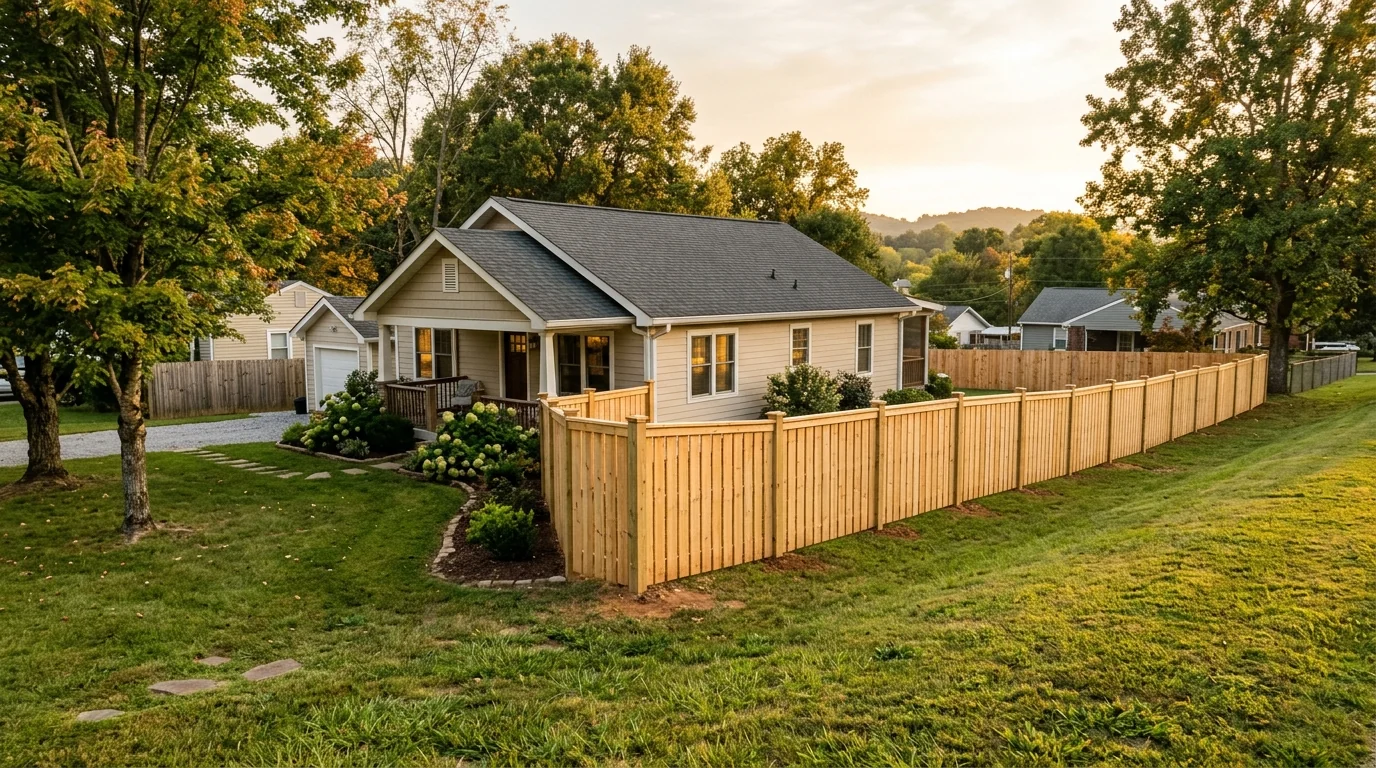
Service area · Tennessee
Fence installation in Rockford
Rockford is a small city in Blount County, Tennessee, part of the Knoxville metro area. Its mix of clay-heavy soils, sloped terrain, and rural-to-suburban land patterns creates specific demands for fence post depth and material selection. Homeowners here benefit from contractors who understand Blount County soil series and local permitting rules.
Typical foundation type: pier-and-beam
Why Rockford Fence Installation Is Different
Rockford sits inside the Knoxville metro area along the western edge of Blount County, bordered by the Little Tennessee River and rolling terrain that rises toward the Smoky Mountain foothills. With a population of around 849, it is a small city, but the demands on fence installations here are anything but simple. The soils documented by the USDA Natural Resources Conservation Service for this area include clay loam and silt loam series with eroded and sloped phases, meaning that what works on a flat suburban lot in another market can fail here within a season or two.
Understanding soil behavior, slope management, and local permitting rules is what separates a fence that lasts from one that starts leaning after the first wet spring.
Soil and Geology in Rockford
The USDA NRCS soil survey for Blount County, accessible through the USGS Soil Data Access service, identifies several soil series relevant to Rockford properties. These include Sequoia silty clay loam in an eroded sloping phase, Emory silt loam in a gently sloping phase, Dandridge silt loam in a moderately steep phase, Alcoa loam in an eroded sloping phase, and Tellico clay loam in a severely eroded steep phase.
Each of these presents a different challenge for fence post installation. Clay loam soils expand when saturated and contract during dry spells. That seasonal movement can shift fence posts that are not set deeply enough or that rely on tamped gravel rather than concrete for support. Eroded sloping phases mean that surface drainage patterns can expose post bases over time if grading is not managed during installation. The Tellico series, noted as severely eroded and steep, requires the most care. Posts on that soil type need to be set with particular attention to anchoring depth and concrete volume.
For posts installed in any of these Blount County soils, This Old House recommends digging holes 3 feet deep to get below the frost line and setting posts in wet concrete with a level confirming plumb before the concrete sets. That guidance aligns with the conditions found in Rockford.
Climate Considerations for Rockford Fences
Rockford shares the broader Knoxville metro climate pattern. East Tennessee experiences hot, humid summers and winters that bring occasional freezing temperatures and moisture cycles that stress fence materials. Wood is the most popular residential fencing material in the South, accounting for roughly 65 percent of residential demand nationally, but it requires more attention in humid climates where moisture penetrates end grain and accelerates rot at ground contact points.
For families choosing between materials, vinyl holds up well against the humidity cycles common in the Knoxville metro. Bob Vila reports vinyl fence installation costs between $15 and $40 per linear foot, with six-foot privacy panels averaging $25 to $40 per linear foot. Wood privacy fencing, per Bob Vila’s wood fence cost guide, runs $27 to $60 per linear foot installed. Both materials perform well in this climate when properly installed, but vinyl requires less annual maintenance.
Housing Era and Property Patterns in Rockford
Rockford is not a large planned subdivision community. The housing stock reflects a gradual rural-to-residential transition that has accelerated as the Knoxville metro expanded southward into Blount County. Properties range from older farmhouse-era homes on large parcels to newer single-family homes on subdivided lots closer to the SR-333 corridor and Maryville Road. That variety means fence projects here rarely follow a single template.
Older properties may have pre-existing fence lines, tree roots interfering with post placement, or irregular lot shapes that require custom panel sizing. Newer homes in tighter subdivisions may have HOA restrictions on fence height and material. Getting clarity on both before requesting quotes saves time and avoids surprises.
Rockford Neighborhoods and Fence Patterns
Rockford’s residential areas follow the town’s geography, clustering near the Little Tennessee River, along rural county routes, and on the hillside grades that rise toward Blount County’s interior.
- Rockford Town Center area. The most concentrated residential density in the city. Smaller lots mean privacy fencing is often the primary driver.
- Little Tennessee River corridor. Properties near the river face slope and drainage considerations. Stepped panel installation is common here.
- Maryville Road residential stretch. A mix of older single-family homes and newer infill. Post depth requirements vary by soil series encountered during dig.
- Louisville Road corridor. Larger rural parcels where split-rail and farm-style fencing appear alongside residential privacy installations.
- Hillside residential areas west of SR-333. Elevated lots with Dandridge or Tellico soil phases. Contractors need experience with racked panels and uneven terrain.
- Farmland tracts bordering Alcoa city limits. Agricultural fencing transitions to residential privacy fence as parcels subdivide.
- River Road residential parcels. Waterfront-adjacent lots where seasonal water table changes affect post stability.
- Blount County rural routes near Rockford. Larger properties where perimeter fencing for livestock or pets covers several hundred linear feet.
How to Find a Rockford Fence Installation Contractor
Choosing a fence contractor in a small market like Rockford requires more scrutiny than in a larger city where dozens of established firms compete. Four criteria matter most here.
Warranty terms tied to installation, not just materials. Material warranties from manufacturers cover defects in the product, not installation failures. In Blount County’s clay soils, a post that leans within a year is almost always an installation problem. Ask any contractor whether their workmanship warranty covers post movement and for how long. A contractor confident in their post-setting technique will answer that question directly.
Demonstrated experience with sloped and eroded terrain. Show your contractor the lot, particularly any areas with visible erosion, slope transitions, or drainage channels. Ask specifically how they handle racked panels on grades and what concrete volume they use per post on sloped installations. Generic answers signal a contractor who has not worked this terrain before.
Local Blount County project references. A contractor based in Maryville or serving the Knoxville metro regularly will have completed jobs in Rockford or nearby communities with similar soil conditions. Ask for the city or road name for recent projects, not just a general “we work in the area” response. Three verifiable local references from the past 18 months is a reasonable standard.
Diagnostic discipline before quoting. Reliable contractors measure the actual perimeter, identify gate locations, note slope transitions, and check for buried utilities before quoting. A contractor who provides a price per linear foot over the phone without visiting the site is estimating, not quoting. That difference often shows up later as change orders.
For a free on-site fence quote in Rockford, an in-person assessment is the only way to get accurate pricing for a sloped or irregularly shaped lot.
What to Expect from a Rockford Fence Inspection
A thorough pre-installation inspection for a Rockford property covers four areas.
Exterior perimeter walk-around. The contractor measures the full fence line, notes any elevation changes, identifies tree roots or hardscape that complicate post placement, and confirms property line markers. On eroded sloping soil, this step also identifies where additional concrete or deeper post holes are needed.
Gate and access point assessment. Gates on sloped terrain are prone to sagging if the hinge post is not set correctly. The inspector identifies gate locations relative to drainage patterns and grades, and notes whether self-closing hardware is needed for pool compliance. The U.S. Consumer Product Safety Commission specifies that pool gates must be self-closing and self-latching, with the top of the barrier at least 48 inches above grade on the pool-facing side.
Soil condition check at post locations. On Blount County soil series, an experienced contractor will probe post locations to identify clay concentration, rock near the surface, or saturated zones that require modified anchoring. This step directly affects the quote for concrete volume and labor time.
Slope and drainage review. For properties along the Little Tennessee River corridor or on hillside grades west of SR-333, the contractor should assess how water moves across the lot during heavy rain. Poor drainage can undermine post bases even when concrete is used, if water channels toward the fence line repeatedly.
Fence Types Used Most Often on Rockford Properties
The terrain and housing mix in Rockford shapes which fence types make the most practical sense. Here are the options contractors install most often, with cost guidance from Bob Vila.
- Wood privacy fence. The most common choice for residential lots where screening from neighbors is the primary goal. Bob Vila reports wood privacy fencing at $27 to $60 per linear foot installed. See the full breakdown at wood fence cost and options. On sloped lots, board-on-board construction allows slight adjustments between panels.
- Vinyl privacy fence. A strong second choice for homeowners who want low maintenance. Bob Vila puts vinyl fence cost at $15 to $40 per linear foot, with taller panels running higher. Vinyl panels on sloped terrain require racking or stepped installation. See vinyl fence installation methods for how contractors handle this locally.
- Chain-link fence. Common for larger rural parcels and pet containment on Blount County acreage. Bob Vila cites chain-link at $15 to $30 per linear foot installed. Chain-link conforms to grade changes more easily than panel fencing, making it practical for rough terrain.
- Split-rail fence. Used on larger agricultural-transition properties near the Louisville Road corridor. Bob Vila reports split-rail at $12 to $30 per linear foot. Best for property definition rather than privacy or containment.
- Aluminum or ornamental fence. Suited for decorative perimeter fencing near front yards or pool enclosures. Bob Vila puts aluminum fence cost at $17 to $90 per linear foot, with labor adding $30 to $80 per hour. Aluminum does not rust, which matters in the humid Knoxville metro climate.
For a complete overview of fence installation costs in the Knoxville area, the cost hub breaks down pricing by material and project size.
Rockford Building Permits for Fence Installation
Rockford is a city within Blount County, and for most permitting purposes, residential fence projects fall under Blount County Building and Codes department jurisdiction. Tennessee adopted the International Residential Code and International Building Code framework, and Blount County enforces those standards for residential construction, including fencing.
Whether a permit is required depends on several factors: fence height, proximity to property lines, whether the fence is part of a pool enclosure, and the zoning classification of the parcel. In most Tennessee jurisdictions, fences under a certain height (commonly six feet) in rear and side yards do not require a permit, while taller fences or front-yard installations above four feet often do. Pool fences are separately regulated and almost always require a permit and inspection.
Before breaking ground, the homeowner or contractor should contact the Blount County Regional Planning Commission and Building Safety department to confirm current requirements. This step protects against situations where a fence must be modified or removed after installation to achieve code compliance. Contractors who regularly work in Blount County will already be familiar with this process and can pull permits on the homeowner’s behalf as part of the project contract.
For questions about fence repair and code compliance on existing fences, older fence lines sometimes fail inspection when a property is sold, and understanding what triggers a permit requirement helps homeowners plan ahead.
Other Tennessee Cities in the Knoxville Metro We Serve
Rockford sits within a broader service area covering the Knoxville metro and Blount County corridor. If you are looking for fence installation information for a nearby city, these pages cover adjacent markets.
- Fence installation in Knoxville, TN covers the central metro market with its own neighborhood-by-neighborhood soil and housing patterns.
- Fence installation in Alcoa, TN addresses the neighboring Blount County city directly adjacent to Rockford, where lot sizes and soil conditions overlap closely.
- Fence installation in Seymour, TN serves the community east of Rockford along the US-441 corridor toward Sevier County.
Neighborhoods served
Rockford neighborhoods
- Rockford Town Center area
- Little Tennessee River corridor
- Blount County rural routes near Rockford
- Maryville Road residential stretch
- Louisville Road corridor
- Hillside residential areas west of SR-333
- Farmland tracts bordering Alcoa city limits
- River Road residential parcels
Questions
Rockford fence installation FAQs
Why is fence installation more complicated in Rockford than in flat suburban areas?
What does fence installation typically cost in the Rockford area?
Do I need a building permit to install a fence in Rockford TN?
How do I find a fence contractor with real Blount County experience?
What neighborhoods or areas in Rockford see the most fence installations?
Can I get a free fence inspection or quote in Rockford?
What foundation or post type works best in Rockford soil conditions?
Free inspection
Free Rockford fence estimate
On-site elevation survey, written quote within 24 hours, no obligation.