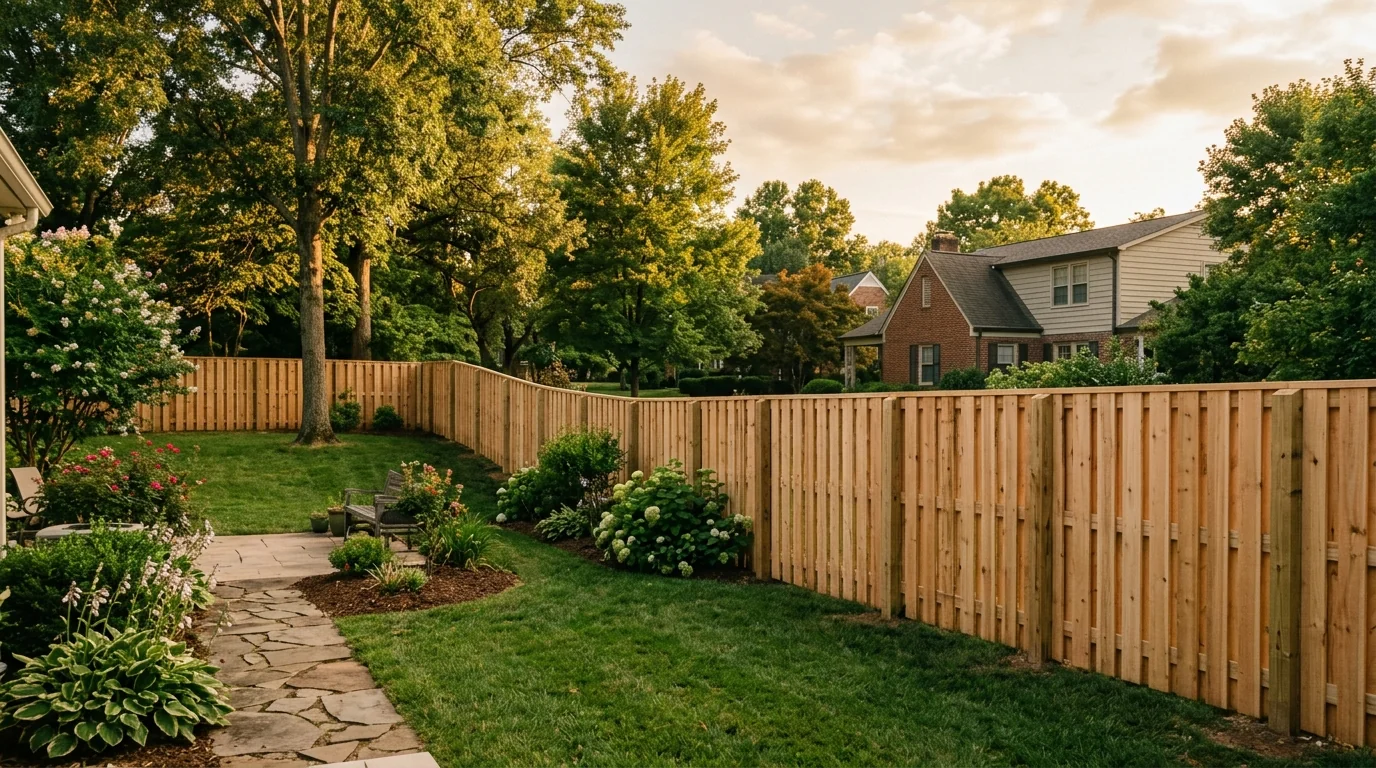
What is privacy fence installation and when is it the right choice?
If you are searching “how much does a privacy fence cost” and wondering whether a full privacy fence is the right project for your Knoxville property, the short answer is this: a solid-board privacy fence is the right choice when you need to block sightlines from adjacent homes or streets, contain children or pets within your yard, and define your property boundary with a structure that reads as finished and intentional. Most Knoxville homeowners in established West Knox neighborhoods, newer Hardin Valley subdivisions, and mid-city infill lots choose privacy fencing because homes sit close together and rear yards face other rear yards with minimal natural screening.
How a privacy fence works mechanically
A privacy fence achieves its purpose through continuous solid-board or solid-panel construction from post to post with no gaps between boards. Posts are set in concrete footings, rails span horizontally between posts, and individual boards or pre-assembled panels attach vertically to those rails. The result is a barrier that blocks direct sightlines at standard 6-foot height while supporting wind loads and the weight of ice accumulation during Knox County winters. Post depth, concrete mix, and board fastening method are the three variables that determine whether the fence holds up for five years or twenty.
Privacy fence installation is the right choice when your lot is relatively flat or gently sloping, when you need 6-foot height to block sightlines from neighboring second-story windows or elevated decks, and when your HOA covenant allows solid-board construction. Knox County’s residual clay and silty clay soils, derived from weathered limestone and dolomite of the Valley and Ridge province (USDA Web Soil Survey, Knox County, Tennessee), hold concrete footings reliably in most yard positions. Posts set to 30 to 36 inches depth perform well on most standard residential lots. Ridge-position lots with shallow bedrock may require rock augering, which adds cost and time.
Conditions where an alternative is better
If your primary goal is low maintenance over a 15-to-20-year horizon and you are comfortable paying more upfront, vinyl privacy fence installation deserves serious consideration. If your goal is defining a property line without blocking airflow or light (say, around a garden or along a side yard with a neighbor who values the open feel), a picket or split-rail style serves better than a solid-board privacy fence. If the installation site is heavily sloped, stepped-panel installation adds complexity and cost regardless of material.
Privacy fence installation process
Understanding the installation sequence helps you evaluate contractor proposals and set realistic expectations for the disruption to your yard.
Step 1: Site assessment and layout (Day 1, first two hours)
The installer walks your property line, marks post locations with spray paint or flags, and checks for underground utilities. In Knox County, Tennessee 811 (call before you dig) is required before any augering. The crew confirms gate positions, checks for slope changes requiring step-down panel placement, and reviews any HOA setback requirements with you before digging begins.
Step 2: Post hole augering and setting (Day 1, main work)
Holes are augered or hand-dug to 30 to 36 inches depth for standard Knox County soil conditions. This Old House’s vinyl fence installation guide recommends digging to at least 3 feet to get below the frost line, which aligns with standard practice across Knox County. Posts are plumbed with a level, braced temporarily, and packed with concrete. For a 155-linear-foot project (the Knox County average), expect 20 to 30 post holes on a standard layout with one or two gates.
Step 3: Concrete cure (Day 1 evening or Day 2 morning)
Concrete should cure a minimum of 24 hours before rails and boards are attached. Wet conditions, common during Knoxville spring and fall, extend the recommended cure window. Crews that skip this step risk posts shifting under the weight of panels before the concrete has fully set.
Step 4: Rail installation (Day 2)
Horizontal rails attach to posts with post brackets or are toenailed into notched posts, depending on the contractor’s preferred system. Most residential privacy fences use two rails for fences up to 5 feet and three rails for 6-foot fences. A three-rail system distributes wind load more evenly, which matters during the kind of sustained wind events Knox County experiences with remnant tropical systems. Remnants of Hurricane Helene in September 2024 caused significant wind and saturation-driven tree failures across East Tennessee, and fences in the storm’s path with only two-rail construction failed at higher rates than three-rail installations.
Step 5: Board or panel installation (Day 2 to Day 3)
For board-on-board or shadowbox wood construction, individual boards are nailed or screwed to the rails with consistent spacing. For pre-fabricated panel systems, sections slide or clip into place. The installer maintains a consistent height above grade, accounts for any slope transitions, and trims boards at gate openings for a clean fit.
Step 6: Gate installation and hardware (Day 3)
Gate posts are set deeper than line posts (typically 42 to 48 inches) to handle the additional stress of a swinging load. Hardware includes hinges rated for the gate weight, a drop rod or latch, and a self-closing mechanism if the fence encloses a pool. The U.S. Consumer Product Safety Commission requires pool barrier gates to be self-closing and self-latching, and Knox County IRC enforcement follows the same standard for any fence serving as a pool barrier.
Step 7: Final walkthrough and cleanup
A professional crew removes concrete debris, trims any board ends to a consistent height, and walks the fence line with you before leaving. Uneven board heights, visible concrete spills at grade, and misaligned gate latches are the three most common punch-list items on residential installs.
Wood privacy fence vs vinyl privacy fence
The wood versus vinyl fence question is the most common material decision Knox County homeowners face, and the honest answer is that neither material wins outright in every situation.
Wood, specifically pressure-treated Southern Yellow Pine, is the standard residential choice across Knoxville and the surrounding county. It costs less upfront, repairs more easily (a single rotted board swaps out in 20 minutes), and carries the natural look that many HOA covenants in established neighborhoods were written to require. The problem in Knoxville is moisture. With 47.9 inches of average annual rainfall (NWS Morristown, KMRX, 1991-2020 Climate Normals), untreated or poorly sealed Southern Yellow Pine begins to gray within one season and can develop surface rot within three to five years without regular sealing or staining. A wood fence is not a set-and-forget installation in this climate.
Bob Vila’s Wood Fence Cost guide puts wood privacy fence cost at $27 to $60 per linear foot installed. Bob Vila’s Vinyl Fence Cost guide puts 6-foot vinyl panels at $25 to $40 per linear foot, with 8-foot vinyl at $30 to $45. The installed cost overlap between the two materials is tighter than most homeowners expect.
Vinyl outperforms wood on long-term maintenance. A vinyl fence in Knoxville requires nothing more than periodic rinsing. It will not rot, it will not need staining, and it holds color without fading under the intense summer sun that the Knoxville metro sees from June through September. The trade-off is that vinyl repairs are less forgiving. A cracked vinyl post cap or a panel section from a discontinued color run may require sourcing from the original manufacturer, whereas a split wood board is replaceable at any lumber yard.
For buyers in West Knox HOA communities, the picture gets more specific. Aluminum ornamental fencing is popular in Northshore and Choto lakefront communities where HOA covenants specify a more finished, formal appearance. If your primary motivation is containment of children and pets combined with full privacy, solid-board wood or vinyl is the clear answer. If your lot fronts a street and the HOA allows only decorative styles in front yards, a combination of ornamental fence in front and privacy fence in the rear is a common Knox County solution.
When to choose vinyl privacy fence installation in Knoxville: you plan to stay in the home more than ten years, you want to eliminate maintenance cycles, or you are building a fence that will be difficult to access for repainting (along a steep slope or backing up to a densely planted area).
Privacy fence cost in Knoxville, TN
How much does a privacy fence cost in Knoxville? Local projects typically run $1,900 to $5,800 for a standard residential installation, based on the Knox County average project size of approximately 155 linear feet.
The national range from Bob Vila’s Wood Fence Cost guide is $1,763 to $4,416 for wood, with privacy fence specifically cited at $27 to $60 per linear foot installed. Vinyl runs $2,292 to $5,799 nationally according to Bob Vila’s Vinyl Fence Cost guide, with a national average of $4,045.
Several local variables push Knoxville projects above or below the national midpoint.
Terrain and soil. Flat suburban lots in Hardin Valley or Karns stay close to the per-linear-foot average. Ridge-position lots with shallow limestone bedrock require rock augering at added cost per post. Karst-related drainage issues in low-lying yard positions may require gravel drainage around post footings to prevent premature post heave during Knox County’s wet seasons.
Linear footage and gate count. Each gate adds $200 to $600 to the project cost depending on width, hardware, and whether a self-closing mechanism is required. A double-drive gate for backyard vehicle access is a significant line item.
Access. Narrow side yards (common on in-fill lots in North and East Knoxville), steep slopes, and mature tree roots that require hand-digging around increase labor hours and cost.
Material grade. Standard #2 pressure-treated pine is the budget option. Pressure-treated cedar or redwood costs more per board but accepts stain more evenly and holds up better in Knoxville’s humid conditions without the chemical smell of fresh CCA-treated pine.
For a project-specific number tied to your lot, request a privacy fence installation quote for your Knoxville property so a local installer can walk your fence line and account for grade changes, gate positions, and soil conditions.
You can also review the detailed privacy fence installation cost breakdown for Knoxville for a line-item look at how labor, materials, and permit fees factor into the final number.
Warranty and transferability
A strong warranty for privacy fence installation covers two distinct things: the labor and workmanship, and the material itself. These are separate warranties from separate parties.
Contractor labor warranties in the Knoxville market typically run one to five years, covering post heave, panel misalignment, or gate hardware failures that result from installation errors rather than weather events. When reviewing contractor proposals, ask specifically whether the warranty covers post settlement and whether it is transferable if you sell the home. A transferable warranty adds marketable value to your home; a non-transferable warranty ends the day the property changes hands.
Material warranties vary by product. Pressure-treated pine carries a manufacturer warranty (typically 20 to 30 years against rot and termite damage when properly installed and maintained) but this warranty is on the raw lumber, not the installed fence. Vinyl fence manufacturers commonly offer 20-to-50-year limited warranties on the material, with some brands offering lifetime coverage against cracking, peeling, or color fade.
Ask any contractor for written documentation of both warranties before signing a contract. Verbal assurances about “standing behind the work” are not enforceable. The American Fence Association’s industry standards provide a baseline for what professional installation should include, and using an AFA-member contractor is one way to verify that a company operates under a recognized professional framework.
Permits and engineering in Knoxville, TN
Permit requirements in Knox County depend on where exactly your property sits, and the three relevant jurisdictions have meaningfully different rules.
City of Knoxville. A permit is required for any fence over 6 feet in height, and for any fence within a historic overlay district regardless of height. Contact City of Knoxville Plans Review and Inspections to confirm whether your parcel falls within an overlay zone before installing even a standard-height fence. Many mid-city and Fourth and Gill district properties carry overlay restrictions that affect material choice and design.
Town of Farragut. Farragut operates its own community development office with notably stricter fence permitting and design review standards than either the city or the county. West Knox homeowners in Farragut should contact the Town of Farragut Community Development office early in the planning process. HOA approval from your subdivision covenant and Town of Farragut permit approval are two separate processes, and both are required.
Unincorporated Knox County. Knox County Codes Administration and Inspections handles permit applications for properties outside city and town limits. Permits are required for fences over 6 feet. Typical permit fees run $40 to $90.
For pool barrier fencing specifically, IRC requirements apply across all three jurisdictions. Pool barriers must reach a minimum of 48 inches above grade on the exterior face, and gates must be self-closing and self-latching, per CPSC pool safety guidelines. Corner-lot setback rules differ between jurisdictions, so confirm your front and side setbacks before staking your fence line.
If your project involves any grading, retaining walls adjacent to the fence, or any work within a mapped floodplain, additional engineering documentation may be required. Knox County’s karst limestone geology means that drainage patterns on your lot can behave unexpectedly, and a soil disturbance that looks routine can intersect with subsurface drainage channels in ways that affect neighboring properties.
Homeowners researching fence repair in Knoxville after a previous installation failed because of improper post depth or missing permits often discover that unpermitted work complicates insurance claims and future sale disclosures. Pulling the permit is the low-cost step that protects the investment.
For more on how the Knoxville metro’s specific soil and climate conditions affect fence performance and installation decisions, see the Knoxville fence installation service area overview.