Service area · Tennessee
Fence installation in John Sevier
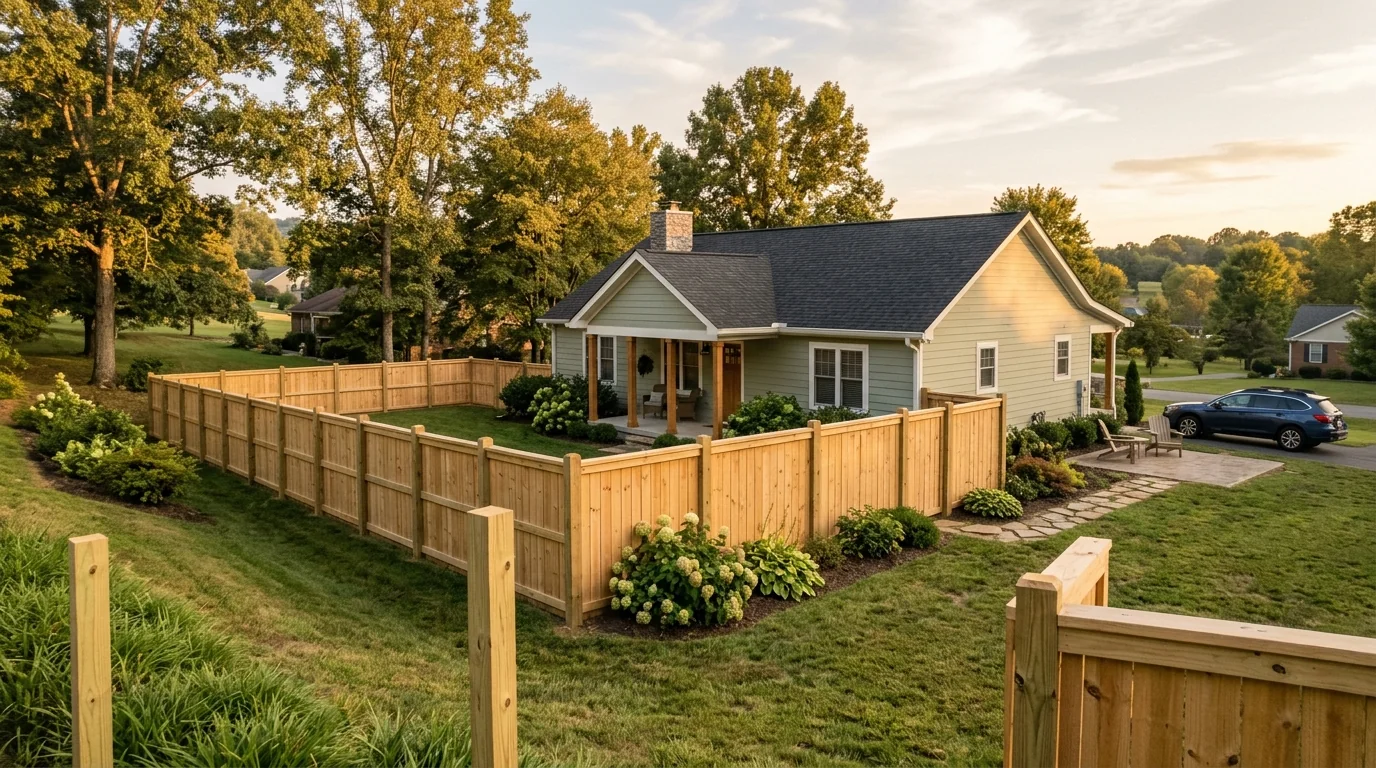
John Sevier is a small Knox County community of roughly 833 residents sitting in hilly terrain east of Knoxville. Steep Dewey silt loam soils and eroded slopes make post-setting more demanding than flat suburban sites. Local homeowners need a fence contractor who understands how grade changes affect post depth, panel alignment, and long-term stability.
Typical foundation type: mixed
Why John Sevier Fence Installation Is Different
John Sevier sits in the rolling hill country east of Knoxville, tucked into Knox County’s quieter rural-suburban fringe. With a population of roughly 833 residents, it is a place where lot lines often follow natural contours rather than straight surveyed grids. That means fence contractors who quote by linear foot over the phone, without visiting the site first, routinely underprice the job and then struggle to deliver a straight, stable result. The Dewey silt loam soils that dominate this area introduce real engineering considerations that set John Sevier apart from flat suburban Knoxville markets like Powell or Halls.
Soil and Geology
The USDA’s USGS SSURGO soil data identifies three soil units covering most of John Sevier’s residential lots. The first is Dewey silt loam on 15 to 25 percent slopes, already eroded. The second is Dewey loam on 25 to 40 percent slopes, also eroded. The third is a Dewey-Udorthents-Urban land complex covering the more moderate 2 to 12 percent slope areas near roads and older developed parcels. In plain terms, these are silty, erosion-prone hillside soils where the topsoil layer has been thinned by decades of runoff. Post holes that would find solid bearing at 30 inches on a flat Knoxville lot may need to go 42 to 48 inches here to reach the undisturbed subsoil. This Old House notes that post holes should reach at least 3 feet deep to get below the frost line, and on eroded slopes in John Sevier that minimum is a starting point rather than a target.
Climate
John Sevier shares the broader Knoxville metro climate: humid subtropical conditions with hot summers, mild winters, and year-round rainfall spread fairly evenly across seasons. That moisture pattern matters for fence material choice. Wood fences absorb and release moisture repeatedly through Tennessee’s wet springs and dry late summers, which accelerates post rot at the soil line on hillside lots where surface water channels naturally toward low points. Vinyl and aluminum options resist that moisture cycling, though they still require properly set posts to handle wind loads on exposed ridge-line lots. Homeowners planning to enclose yards for children or pets should factor material durability into the decision alongside upfront cost. See the fence cost hub for a full material comparison.
Housing Era
John Sevier’s housing stock reflects Knox County’s broader pattern of mixed-era development. Older homes along the main road corridors date to mid-century construction, often sitting on pier-and-beam or mixed foundation systems suited to hillside sites. Newer infill construction has appeared on lots that were previously too steep for economical development, but those sites present the steepest grading challenges for fence lines. Regardless of when a home was built, the sloped terrain means property lines rarely run level, and fence panels must either step down the hill in a stair-step pattern or rack (angle) continuously with the slope. Each method has aesthetic trade-offs, and the right choice depends on the degree of slope and the material selected.
John Sevier Neighborhoods and Patterns
The community does not carry formally designated subdivisions the way larger Knoxville suburbs do, but several distinct residential pockets have developed along the road and creek corridors of this part of Knox County.
- Mascot Road Corridor. Mixed older and mid-century homes on moderate slopes. Lot sizes vary widely; survey confirmation before fence installation is strongly recommended.
- Midway Community. A scattered rural-residential area with larger lots. Split-rail and farm-style fencing are common for property definition rather than privacy.
- Kodak Road Area. Light commercial and residential mix along the main arterial. Side-yard and rear-yard privacy fences appear frequently on homes set close to the road.
- Riverdale. Low-lying parcels closer to the creek corridor. Frost heave and seasonal moisture are concerns for post stability; concrete-set posts with proper drainage are essential.
- McCloud Hollow. Steeper terrain in a creek hollow setting. Post-setting on 25-plus percent slopes is the norm here; stepped panel runs are almost always required.
- Lakeview Heights. Elevated ridge-top lots with long sightlines. Wind exposure on these sites argues for thicker posts and shorter panel spans.
- Rutledge Pike Vicinity. The main highway corridor bringing Knox County’s suburban character close to John Sevier. HOA rules may apply to newer subdivisions along this stretch.
- New Harvest Area. Newer residential development on formerly agricultural land. Flatter by local standards, but drainage from uphill Dewey loam soils still matters for post placement.
How to Find a John Sevier Fence Installation Contractor
Finding a contractor who can handle John Sevier’s terrain is different from hiring for a flat suburban job. Four criteria matter most.
Warranty terms tied to post movement. A hillside installation warranty should explicitly cover post heave, lean, and settlement, not just material defects. Ask whether the warranty covers labor to re-plumb a post that has shifted within the first two years. Contractors confident in their post-setting practices will answer that question without hesitation.
Demonstrated local-terrain experience. Ask the contractor to describe a recent project on a 25-plus percent slope in Knox County. They should be able to explain whether they used stepped panels or continuous racking, and why they chose one over the other for that site. Generic answers about “years in business” don’t tell you whether they understand Dewey silt loam behavior.
Diagnostic discipline before quoting. A contractor who quotes a John Sevier job over the phone without a site visit is guessing. The variability in slope, soil depth, and access across this small community means accurate pricing requires a walk of the actual lot. Request the free inspection and quote before agreeing to any numbers.
Transparency about permits and setbacks. Knox County has building code requirements that govern fence height and setbacks. A contractor who cannot name the permitting office or who suggests skipping the permit to save time is not protecting your interests. See the permits section below for jurisdiction details.
What to Expect from a John Sevier Inspection
A professional fence inspection in John Sevier should cover four distinct areas before a quote is finalized.
Exterior perimeter walk. The contractor walks the full fence line as you intend it, marking changes in grade, identifying any retaining walls or drainage swales that a fence must cross or avoid, and flagging property line markers. On Dewey loam slopes, this walk often reveals micro-terrain features like erosion channels that affect post spacing.
Interior yard assessment. Gate placement, utility access points, and any buried infrastructure (irrigation, buried cable, septic laterals) are noted. John Sevier homes on hillside lots sometimes have unusual utility routing to navigate around the topography.
Soil-depth probing. On eroded Dewey silt loam, a quick probe with a hand tool or auger confirms how deep firm bearing soil sits. This directly determines post depth and, therefore, material cost. Skipping this step is how contractors end up with leaning posts six months after installation.
Slope-and-drainage assessment. The contractor should note which direction surface water flows across the yard and whether any post positions sit in natural drainage paths. Fence posts set in a drainage path without proper gravel backfill will rot or heave faster than posts on well-drained soil. This assessment also informs whether a stepped or racked panel run is more practical for each section of fence.
Repair Methods Used Most Often in John Sevier
When fences fail on John Sevier’s hillside lots, the cause is almost always related to post movement or moisture, not panel damage. The repair methods used most often here reflect that pattern.
- Post reset and re-plumb. The most common repair on sloped lots. A shifted post is excavated, re-plumbed, and re-set in fresh concrete with gravel drainage at the base. Bob Vila notes that fence installation costs $13 to $25 per linear foot on average, and post-reset pricing typically tracks labor costs in that same range for small sections. See fence repair options for Knox County homes for a full breakdown.
- Panel replacement on stepped runs. When a stepped panel section warps or splits, the individual panel is replaced without disturbing the posts. Wood panel replacement is straightforward; vinyl panel replacement requires matching the original profile.
- Gate rehang and hardware replacement. Gates on sloped lots work against gravity on every swing cycle, wearing hinges faster than on flat installations. Rehanging with heavy-duty hardware and adjusting the latch strike plate is a routine service call on John Sevier properties.
- Full section replacement after erosion undermining. On the steepest Dewey loam slopes, surface erosion occasionally scours soil away from around a post base, exposing it and undermining panel alignment. This requires a full section pull-and-reset rather than a simple re-plumb. See the fence installation methods guide for detail on how contractors approach full-section work.
For material-specific cost guidance, the wood fence cost spoke and vinyl fence cost spoke both carry current per-linear-foot ranges cited from Bob Vila’s vinyl fence cost guide, which puts vinyl installation at $15 to $40 per linear foot, with a national average project cost of $4,045.
John Sevier Building Permits
John Sevier is an unincorporated community, which means it falls under Knox County jurisdiction rather than a municipal code office. Fence permits for unincorporated Knox County properties are handled through Knox County Building and Codes, located in downtown Knoxville. Tennessee adopted the International Building Code as its base code, and Knox County enforces height and setback standards that affect residential fencing.
Most residential privacy fences exceeding 6 feet in height require a permit in Knox County. Fences in front yards may face additional height restrictions depending on the road classification of the adjacent street. Pool enclosure fencing carries its own mandatory requirements: the U.S. Consumer Product Safety Commission recommends a minimum barrier height of 48 inches measured on the side facing away from the pool, with self-closing, self-latching gates that open outward from the pool.
Homeowners in newer subdivisions along the Rutledge Pike corridor should also check whether a homeowners association has recorded covenants that impose additional material or height restrictions on top of county minimums. HOA rules exist alongside county code and can be more restrictive. Your fence contractor should ask about both before submitting a permit application.
Other Tennessee Communities We Serve
John Sevier sits within a broader network of Knox County and East Tennessee communities where terrain and soil conditions create similar fencing challenges.
- Homeowners in the adjacent community can review the Mascot fence installation service area for neighboring project examples on comparable Dewey loam terrain.
- Families closer to the Tennessee River valley will find relevant material and cost information on the Rockford fence installation page.
- For the main Knoxville metro service hub, the Knoxville fence installation page covers city-specific permit offices, neighborhood patterns, and material recommendations across the full urban market.
Neighborhoods served
John Sevier neighborhoods
- Mascot Road Corridor
- Midway Community
- Kodak Road Area
- Riverdale
- McCloud Hollow
- Lakeview Heights
- Rutledge Pike Vicinity
- New Harvest Area
Questions
John Sevier fence installation FAQs
Why is fence installation harder in John Sevier than in flatter Knoxville neighborhoods?
How much does a wood privacy fence cost in John Sevier?
Do fence projects in John Sevier require a building permit?
How do I find a reliable fence contractor in the John Sevier area?
What neighborhoods or districts make up the John Sevier community?
Can a fence company inspect my John Sevier property before I commit to a quote?
What is the typical foundation type in John Sevier, and does it affect fence planning?
Free inspection
Free John Sevier fence estimate
On-site elevation survey, written quote within 24 hours, no obligation.