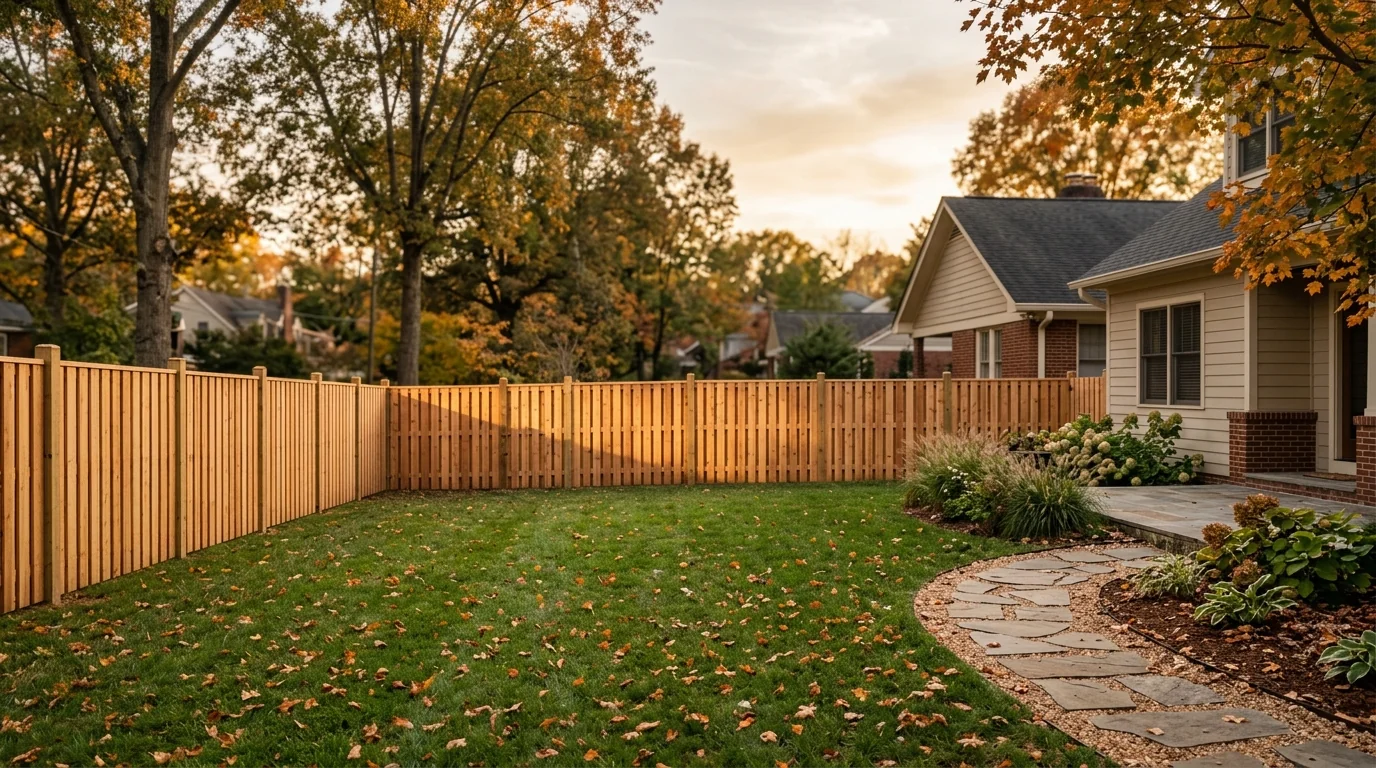
Wood vs vinyl fence: which one is right for your Knoxville yard?
The wood vs vinyl fence question comes up on nearly every estimate call in the Knoxville area, and the honest answer is that wood wins on upfront price and repairability while vinyl wins on long-term maintenance. For most Knox County homeowners, wood is still the first serious look because it costs less to install, can be customized on the jobsite, and fits the aesthetic of the region’s mix of older neighborhoods and newer suburban developments.
That said, wood in Knoxville faces genuine environmental pressure. Knox County averages 47.9 inches of annual rainfall (NWS Morristown, 1991-2020 Climate Normals), and the residual clay and silty clay soils of the Valley and Ridge province hold moisture against post bases longer than sandy ground does. If you skip maintenance, a pressure-treated pine fence in this climate will show its age faster than the same fence in a drier market. Knowing that upfront lets you make the right call for your property and your schedule.
How wood fence installation works mechanically
Wood fence construction follows a post-in-ground framework. Treated pine or cedar posts are set in concrete-filled holes, rails are attached horizontally between the posts, and pickets or boards are fastened to the rails to complete the fence face. The structural load travels from the panels into the rails, then into the posts, and finally into the concrete footing. Post depth in Knox County is typically 30-36 inches, which clears the moderate frost depth of the region and anchors the post in more stable, less moisture-variable subsoil.
When wood installation is the right choice
Wood is the stronger choice when upfront cost matters, when you want flexibility in height or board spacing, or when you expect to make repairs yourself over the fence’s life. The material is universally available at Knoxville-area lumber yards and home centers, replacement boards are inexpensive, and a skilled carpenter can modify the design on the fly if your lot has grade changes or tight corners. For properties in older Knoxville neighborhoods where homes are close together and visual privacy is the primary goal, a 6-foot board-on-board privacy fence in pressure-treated pine delivers results at a price that fits most household budgets.
When vinyl or another option is the better fit
Vinyl becomes the stronger argument when the homeowner genuinely will not maintain a wood fence. West Knox subdivisions in Farragut, Hardin Valley, and the Northshore corridor frequently see vinyl installs because HOA rules require a consistently clean appearance, and vinyl requires only periodic washing rather than periodic staining. If your HOA specifies a particular fence profile or color, vinyl manufacturers offer a wider palette of consistent, factory-finished options than stained wood can reliably match year over year. See the vinyl fence installation option for Knoxville homeowners for a full breakdown of that path.
How wood fence installation works: the process step by step
A professional wood fence install in Knoxville typically runs one to three days for a standard residential privacy fence in the 100-200 linear foot range. Here is what the crew does and when:
Day 1: Layout, digging, and post setting
The installer walks the property line with the homeowner and marks post locations, typically every 6-8 feet on center. Before any digging, Tennessee law requires a call to 811 (Tennessee One Call) to mark underground utilities. Post holes are dug with a tow-behind or hand-held auger to 30-36 inch depth. In ridge-position lots around the Knoxville area where shallow bedrock is more likely, rock augering or a hydraulic driver may be needed. Each post goes into the hole, gets plumbed with a level, and is set in fast-setting concrete. Posts cure for several hours, usually overnight for privacy fence posts carrying heavy panel loads.
Day 2: Rails, pickets, and gates
Once posts have cured, crews attach horizontal 2x4 rails to the posts, typically two or three rails depending on fence height. Pickets or boards are then fastened to the rails with exterior-rated screws or ring-shank nails. Board-on-board privacy styles alternate boards slightly to eliminate gaps while still allowing some airflow. Gates are hung last, with adjustable hinges to account for any minor post variation. The crew checks that each gate swings freely and latches cleanly before moving on.
Day 3 (if needed): Cleanup, touchup, and walkthrough
Larger projects or lots with significant grade changes often need a partial third day. The crew removes concrete bags and debris, backfills any gaps around post bases, and does a final line check. A good installer will flag any boards that developed splits during fastening and replace them before leaving.
Access requirements are straightforward for most Knoxville lots: the crew needs vehicle or trailer access close enough to unload lumber without long carries. On steep or heavily wooded lots, which are common in the foothills neighborhoods east and south of downtown, additional labor for material handling is a real variable in your quote.
Wood fence vs vinyl fence in Knoxville: the honest comparison
The comparison table in the frontmatter captures the side-by-side specifics, but the prose version is worth reading because the edge cases matter here.
Wood wins clearly on upfront cost. According to Bob Vila’s wood fence cost guide, a privacy-style wood fence runs $27 to $60 per linear foot installed. Vinyl, according to Bob Vila’s vinyl fence cost guide, runs $15 to $40 per linear foot for material, with total installed project costs typically landing between $2,292 and $5,799. On a 155 linear foot project (the average Knox County job), wood can come in meaningfully cheaper at the low end.
Wood also wins on repairability. When a Knox County ice storm brings down a tree branch on a wood fence section (a real scenario after the remnants of Hurricane Helene caused widespread tree damage across East Tennessee in September 2024), a crew can replace the affected boards and rails the same week. With vinyl, matching a manufacturer’s panel profile years after original installation can be difficult if the product line has changed.
Vinyl wins clearly on maintenance burden. A wood fence in Knoxville needs staining or sealing every two to three years to hold up against the region’s 47.9 inches of annual rainfall. Skipping that cycle lets moisture penetrate the wood surface, accelerating rot at the post base and rail-to-post connections. Vinyl requires periodic washing but no coating, no sanding, and no color upkeep.
Vinyl also has an aesthetic consistency advantage in HOA-controlled communities. Farragut has some of the most specific fence design standards in Knox County, and vinyl’s factory-finished, consistent color profile is easier to satisfy against a written HOA specification than a stained-wood fence that may weather differently in sun versus shade.
For homeowners who genuinely want to maintain a fence and value customization, wood is the better material. For homeowners who want to install and forget, vinyl is worth the higher upfront cost.
Wood fence installation cost in Knoxville, TN
Bob Vila’s wood fence cost guide puts the national average for a wood fence project at $3,065, with most projects falling in the $1,763 to $4,416 range. Privacy-style fences, which are by far the most common request in Knoxville, run $27 to $60 per linear foot installed.
In the Knoxville market, local variables that push the number higher include:
- Fence height. Six-foot privacy panels use more material than four-foot picket fences. The Town of Farragut’s 6-foot maximum is actually common throughout most HOA neighborhoods, so most Knoxville privacy jobs land at the 6-foot tier.
- Lot grade. Hillside lots in East Knox and the foothills neighborhoods require step-racking or custom-cut panels to follow terrain. That adds labor time.
- Number and style of gates. A single walk gate adds relatively little. Double drive gates with drop rods can add several hundred dollars to a quote.
- Post setting depth. Ridge-position lots with shallow bedrock may require rock augering equipment, which adds a day-rate charge.
- Access difficulty. Tight side yards, mature root systems, or lack of vehicle access all add labor.
For a detailed local cost breakdown, see the wood fence installation cost guide for Knoxville.
If you want a quote specific to your property, schedule a fence installation estimate for your Knox County home.
Warranty and transferability: what to ask before you sign
Warranty coverage on a wood fence comes from two separate sources: the lumber manufacturer’s warranty on the treated wood, and the contractor’s labor warranty on the installation work.
Pressure-treated Southern Yellow Pine, the standard material in the Knoxville market, carries a manufacturer warranty against decay and insect damage that typically runs 15 to 25 years when the product is installed according to its rated use category. For fence posts in ground contact, that means selecting lumber rated UC4A or UC4B. Ask your contractor to confirm the lumber grade and retain the receipt or treatment tag from the lumber yard.
Labor warranties vary widely among Knoxville contractors. One year is common. Five years is available from installers who stand behind their post-setting work. Before signing any contract, ask specifically whether the labor warranty covers post heave or lean from soil movement, since Knox County’s clay soils and moderate shrink-swell potential are the most common cause of fence failure in the first few years after installation.
Ask also whether the warranty is transferable to a new owner if you sell the home. A transferable labor warranty adds a modest but real selling point in a market where buyers are scrutinizing every line item of a home inspection.
The American Fence Association’s industry standards provide a baseline for what professional installation and documentation should look like, and referencing those standards is a reasonable thing to do when evaluating competing bids.
Permits and engineering: what Knox County requires
Permit requirements for a wood fence in the Knoxville metro depend on which jurisdiction your property falls under.
City of Knoxville. A permit is required for any fence taller than 6 feet and for fences in certain overlay or historic districts (including parts of the Old North Knoxville and Fourth and Gill neighborhoods). Contact the City of Knoxville Plans Review and Inspections office to confirm whether your address triggers a permit requirement before installation begins.
Town of Farragut. Farragut applies separate and notably stricter fence permitting and design review requirements beyond standard Knox County HOA rules. The Town of Farragut Community Development office reviews fence applications for conformance with the town’s fence ordinance, which governs material, height, and placement. Homeowners in Farragut should budget additional lead time for this review.
Unincorporated Knox County. A permit is required for fences over 6 feet. Contact Knox County Codes Administration and Inspections. Permit fees across these jurisdictions typically run $40 to $90.
For pool barrier fencing anywhere in Knox County, the International Residential Code requires a minimum height of 48 inches, a self-closing and self-latching gate that opens away from the pool, and no climbable horizontal rails on the pool side. The CPSC Safety Barrier Guidelines for Residential Pools state that “the top of a pool barrier should be at least 48 inches above grade, measured on the side of the barrier which faces away from the swimming pool,” and that “gates should open out from the pool and should be self-closing and self-latching.” A wood fence can meet these requirements with the right design, but confirm with your installer that the gate hardware and rail placement comply before the concrete sets.
Property line questions come up on nearly every fence project. Tennessee does not have a universal fence-line-sharing statute that applies to all municipalities, so boundary fence ownership and neighbor cost-sharing arrangements are generally governed by local ordinance and written agreements between neighbors. Review Nolo’s guidance on fences and boundary disputes for a plain-language overview of how these disputes typically resolve, and consider a plat survey if your property line location is uncertain. Installing a fence on the wrong side of a property line is the most common and most avoidable fence mistake in the Knox County market.
For more information about fence installation across the Knoxville metro, including service area coverage and common repair scenarios, see the fence installation and repair services for the Knoxville area. If your existing fence has specific damage that needs attention before or after a new install, the wood fence repair options for Knox County homeowners cover post rot, leaning sections, and storm damage repairs in detail.