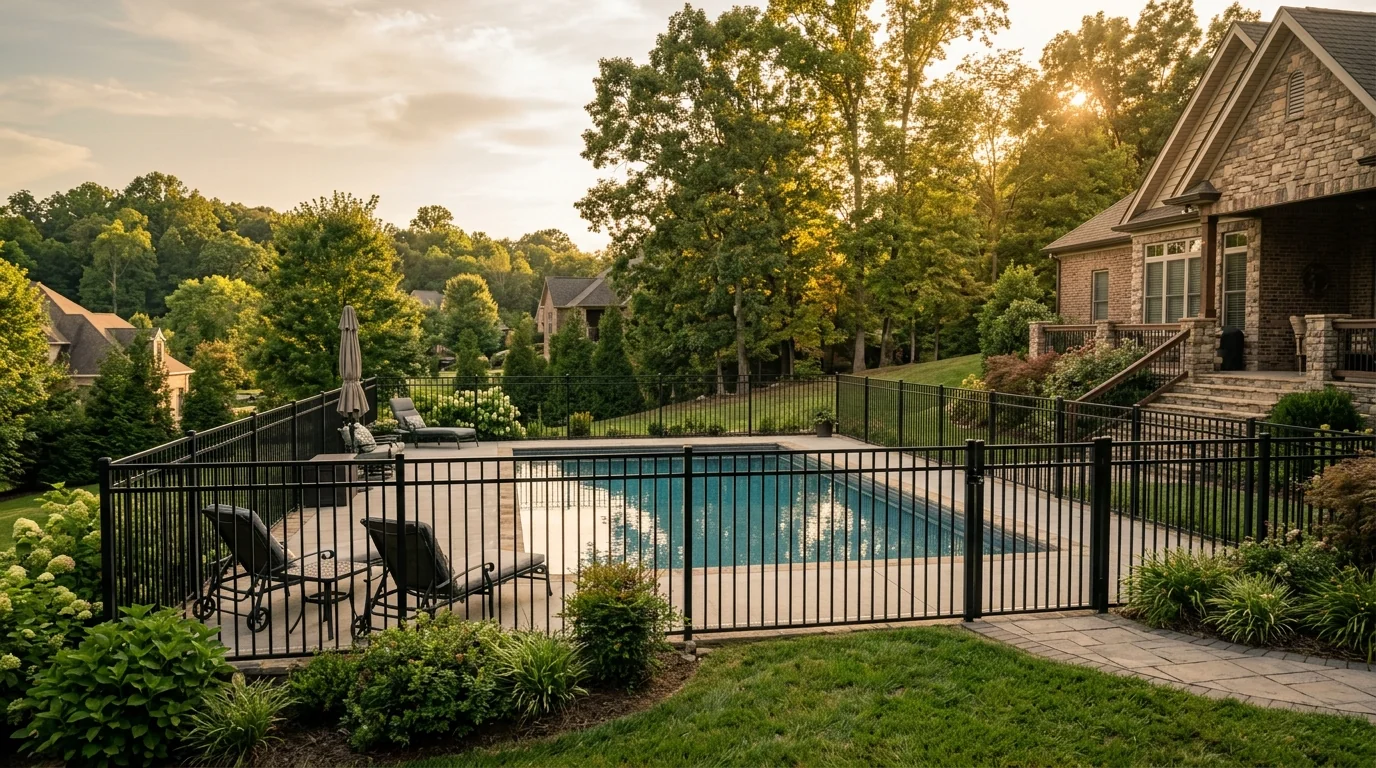
Pool fence installation: what it is and when it is the right choice
Pool fence installation is the process of placing a code-compliant barrier around a residential swimming pool to block unsupervised access. If you have a pool in your Knoxville backyard and young children in the household, or if Knox County issued a certificate of occupancy requiring a pool barrier, this is not a discretionary upgrade. The U.S. Consumer Product Safety Commission estimates that many of the nearly 300 children under age five who drown each year in backyard pools could be saved by complete pool enclosures with self-closing, self-latching gates. The right time to install is before the pool is used, not after a scare.
How pool fencing works mechanically
A pool fence creates a physical boundary that a young child cannot climb, crawl under, or push through. Posts are set into concrete footings at regular intervals around the pool perimeter. Rails span horizontally between posts, and vertical pickets or solid panels fill each bay. Gates are hinged so they swing outward and close under spring tension, latching automatically at a height out of a toddler’s reach. The geometry matters: picket spacing must be narrow enough to prevent a four-inch-diameter sphere from passing through, and the bottom gap from grade to the lowest rail cannot exceed four inches.
The conditions this fence type is designed for
Pool fencing is designed for one primary condition: preventing a child from reaching the water without an adult present. Secondary conditions include containing pets, satisfying homeowners insurance requirements, and meeting the IRC pool barrier provisions that Knox County Code Administration enforces. Aluminum ornamental and vinyl open-picket styles are the dominant choices because they provide clear sightlines so adults can supervise from inside the house, which solid wood privacy panels cannot.
When an alternative is the better answer
If your primary goal is privacy around the pool area rather than a safety barrier, a taller semi-private or privacy panel fence may seem appealing. Solid panels do satisfy barrier requirements as long as height and gap specs are met, but they eliminate the sightline advantage that open-picket aluminum or vinyl provide. For homeowners in Farragut, Northshore, or Choto communities with strict HOA design standards, aluminum ornamental fencing is almost always the approved finish, and installing vinyl or wood may trigger a violation notice. Review your HOA covenants before committing to a material.
Installation process
Step 1. Site layout and code verification (half day before install)
A professional crew marks the fence line using string and stakes, keeping the barrier at least 20 inches away from the pool edge where terrain allows. Before any digging starts, the installer calls Tennessee 811 to mark buried utility lines. Knox County and City of Knoxville both require that pool barriers meet IRC Chapter 3 specifications, so the crew confirms gate placement and post spacing comply before holes are opened.
Step 2. Post-hole excavation (morning of day one)
Posts are dug 30 to 36 inches deep using a gas-powered auger. Knoxville’s karst limestone geology occasionally surfaces as shallow bedrock on ridge-position lots in West Knox neighborhoods. When the auger hits rock before reaching depth, a carbide-tipped rock bit is used to extend the hole, adding roughly one to two hours per problem post. Most valley-position lots in Powell, Halls, and East Knoxville neighborhoods do not have this issue.
Step 3. Post setting and concrete placement (day one, midday)
Steel or aluminum posts drop into the holes and are plumbed with a level before fast-set concrete is poured. This Old House confirms that posts should be set plumb in wet concrete and confirmed level before the concrete begins to set. Post-setting concrete reaches working strength in four to six hours, though full cure takes 24 to 48 hours in Knox County’s moderate summer temperatures.
Step 4. Rail and panel installation (day two)
Once posts are set, the crew inserts rails into post brackets or routed slots and drops picket panels into place. For aluminum ornamental sections, pre-fabricated panel units clip into post collars, which makes panel alignment faster and more consistent than field-assembled styles. Gate hardware, including the self-closing hinge and self-latching catch, is installed and adjusted until the gate swings freely and latches without manual assistance from both directions.
Step 5. Inspection and final gate adjustment
The completed fence is walked from end to end. The installer checks every post for plumb, measures the bottom gap at each bay to confirm it stays under four inches, and tests the gate latch height. Some jurisdictions may schedule a Knox County Codes inspector to sign off on the pool barrier before the pool is opened for use. Confirming this step with Knox County Codes Administration ahead of time avoids delays.
Pool fence installation vs. aluminum ornamental fencing
The comparison between general pool fencing and aluminum ornamental fencing is not always obvious because aluminum ornamental IS the most common material for pool fences in Knoxville’s HOA-dense West Knox corridor. The distinction worth understanding is this: aluminum ornamental is a specific material and style, while pool fence installation is a project type that can use several materials. The right material depends on your neighborhood, your budget, and how you use the pool.
Aluminum ornamental panels arrive from the factory in standardized sections, typically three feet or four feet wide, with uniform picket spacing. That consistency makes installation faster and the finished product more precise. Vinyl open-picket panels offer similar sightlines and cost less per linear foot, but some HOAs in Farragut and Northshore explicitly ban white vinyl near pool areas, classifying it as a residential rather than resort-style finish.
Wood fencing rarely makes sense directly around a pool. Knoxville averages 47.9 inches of rainfall annually, according to NWS Morristown climate normals, and pool decks add consistent moisture from splash and drainage. Wood posts near pool water accelerate rot at the grade line, requiring replacement in eight to twelve years versus thirty or more for aluminum. If budget is the primary driver and wood is already on the rest of the property, a pressure-treated wood barrier can work, but the maintenance timeline and moisture exposure should be factored into the true cost.
For homeowners whose pools are visible from the street in planned communities along Northshore Drive or in Hardin Valley, aluminum ornamental fencing in a black or bronze powder coat is the choice that passes HOA review without a variance request. For homeowners on larger rural lots in the Corryton or Mascot areas where no HOA applies, vinyl can deliver the same safety performance at a lower installed price. Explore the aluminum ornamental fence installation option if HOA compliance is your primary decision factor.
Pool fence installation cost in Knoxville, TN
Material costs vary considerably by type. According to Bob Vila’s fence installation cost guide, aluminum fence installation averages $17 to $90 per linear foot installed, while vinyl runs $15 to $40 per linear foot. A typical Knoxville residential pool perimeter of 80 to 120 linear feet translates to a project cost of roughly $1,360 to $10,800 depending on material selection, gate count, and site conditions. Most pool fence projects in the Knoxville metro fall in the mid-range of that spread.
Several local variables push the number up or down:
- Gate count. Each self-closing, self-latching gate adds to the project cost because gate hardware, hinges, and latch mechanisms are priced separately from panel material. A pool with three access points costs more than one with a single entry.
- Terrain and bedrock. Ridge-position lots in West Knox with shallow limestone bedrock require rock augering, which adds equipment time and crew hours.
- Fence height. The CPSC recommends barriers of 5 feet or higher for better protection. Moving from a 4-foot to a 5-foot fence increases material cost per linear foot by roughly 20 to 25 percent.
- Removal of existing fencing. If a prior fence or landscaping barrier needs to come out before new installation, demo labor adds to the total.
Get a written line-item estimate that breaks out materials, labor, permit fees, and gate hardware separately. Review pool fence installation cost details for the Knoxville area before requesting quotes so you can evaluate bids with context.
Warranty and transferability
A strong pool fence warranty covers two separate things: the material warranty from the manufacturer and the labor warranty from the installer.
Aluminum ornamental fence manufacturers typically offer lifetime structural warranties against rust-through and finish failure under normal conditions. Vinyl manufacturers offer similar lifetime structural coverage, though UV-fade warranties are often limited to ten years. These manufacturer warranties transfer to a new homeowner when the property sells, which is worth confirming in writing before purchase.
The labor warranty covers workmanship defects: posts that were not set plumb, gates that do not latch correctly, or panels that shift because concrete was poured improperly. A professional installer in the Knoxville market should back workmanship for a minimum of one year, with better contractors offering two to five years. Ask specifically whether the warranty is transferable to a buyer, because a pool barrier warranty that transfers can be listed as a feature when selling the home.
When reviewing a warranty, ask the contractor how they handle post settlement on Knox County karst lots. Soil movement over subsurface limestone voids is documented across the county. A contractor who cannot answer that question has probably not done enough pool fence work in this specific geology to back their warranty with confidence.
Permits and engineering in Knox County
Pool barrier permits in the Knoxville metro run through three separate jurisdictions depending on the address.
City of Knoxville requires a permit for any fence located in a historic overlay district or a fence over 6 feet in height. Pool barriers that fall within the standard 4-to-5-foot range and outside overlay districts may not require a separate fence permit, but the pool construction itself almost always has an associated barrier inspection. Contact City of Knoxville Plans Review and Inspections, located at the City County Building on Main Street, to confirm the requirement for your specific parcel before breaking ground.
Unincorporated Knox County requires a permit for fences over 6 feet through Knox County Codes Administration and Inspections. Pool barrier fences under 6 feet may still be subject to a pool-associated inspection even without a standalone fence permit. Knox County Codes Administration is located on Andrew Johnson Highway. Typical permit fees run $40 to $90.
Town of Farragut runs its own permitting and design review through Farragut Community Development, independent of Knox County. Farragut’s standards are meaningfully stricter than the county baseline, covering materials, colors, and placement. Any pool fence project in the Farragut town limits should start with a pre-application meeting at Farragut Town Hall before materials are ordered.
Engineering is not typically required for residential pool fencing at standard heights and spans, but if the fence is attached to a pool deck structure or incorporates a cantilevered gate, a structural detail may be needed. Contact your jurisdiction’s plans review office to ask the question before assuming it is not required.
For a full picture of what pool fencing addresses in terms of site safety and property conditions around Knoxville pools, review fence repair options for Knox County properties and request a site estimate for your pool fence project with measurements and material preferences ready.