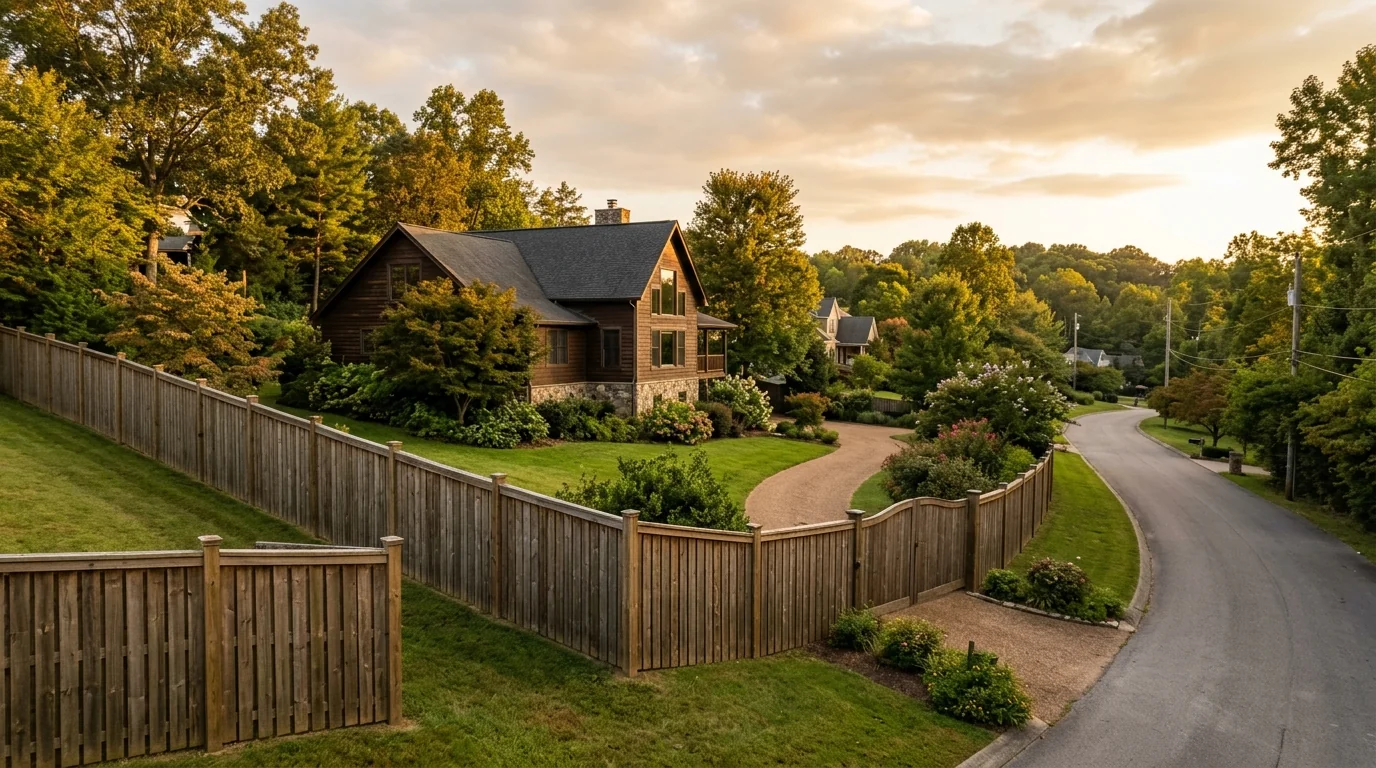
What is security fence installation and when is it the right choice?
Security fence installation puts a physical barrier around a property that is designed to resist unauthorized entry, define a clear perimeter, and create enough of an obstacle that an intruder chooses a different target. In Knoxville, this covers everything from a 6-foot galvanized chain-link fence around a family backyard in Powell to a heavy-gauge welded mesh installation at a commercial property near I-40. The method is the right choice when deterrence, containment, or access control is the primary goal and aesthetics, while still a consideration, come second.
How security fencing works mechanically
Security fencing works by combining height, material strength, and anti-climb features into a system that is physically difficult to breach quickly. Posts are set deeper than decorative fencing, typically 36 to 48 inches into concrete footings, to resist lateral force. The infill panel, whether chain link, welded wire mesh, or steel picket, is chosen for gauge and opening size so that footholds are minimal and cutting requires tools that slow an intruder down long enough to deter the attempt.
The conditions it is designed for
Security fencing performs best when a property has a defined perimeter with clear entry points, when the owner needs to control who enters or exits (including children and pets), and when the site has some exposure to crime, trespass, or liability. Residential properties near commercial corridors, corner lots in South and East Knoxville, homes adjacent to parks or greenways, and any property with a pool or trampoline that creates an “attractive nuisance” liability concern all benefit from a true security fence rather than a purely decorative one.
When an alternative is the better choice
If the property sits inside a West Knox HOA community, particularly Farragut or the Northshore/Choto corridor, ornamental aluminum fencing is almost certainly the better fit. The ornamental aluminum fence installation option for Knoxville properties satisfies most HOA architectural standards while still providing a meaningful visual deterrent. Security-grade chain link and heavy mesh panels are frequently prohibited outright in these communities. If the owner’s goal is primarily curb appeal with secondary deterrence, ornamental aluminum is the more practical path.
Installation process
Security fence installation in Knoxville follows a consistent sequence regardless of material. Here is what to expect from site visit to final walkthrough.
Step 1: Site assessment and layout (day one, 1-2 hours)
A crew leader walks the perimeter, marks post locations with spray paint or flags, and checks for underground utilities through Tennessee 811 (the state’s call-before-you-dig service). On Knoxville lots, this step also identifies whether the terrain requires racking to follow a slope or stepping for steeper grade changes common in the Valley and Ridge geography of Knox County.
Step 2: Post hole excavation (day one, 2-4 hours)
Posts are typically set 36 to 48 inches deep for security fencing. A gas-powered or hydraulic auger handles most Knox County clay soils efficiently. On ridge-position lots where shallow limestone bedrock sits close to the surface, a rock auger or chisel attachment is required. This step is where Knoxville’s karst geology can add time: the crew occasionally encounters unexpected rock just below topsoil on lots that appear level. Contact the local project team for a quote that accounts for subsurface conditions.
Step 3: Post setting and concrete pour (day one, afternoon)
Posts go into the holes and are plumbed with a level. Concrete is poured and allowed to set. Per guidance from This Old House on fence post installation, posts should be plumb before the concrete begins to cure, because corrections after the pour are costly. Most crews let concrete cure overnight before attaching panels, making a two-day project the standard for security fencing with properly set posts.
Step 4: Panel or mesh installation (day two)
Infill panels are attached to posts with tension bands, rails, or welded brackets depending on the system. Chain link is stretched and secured with a come-along to achieve consistent tension. Welded mesh panels are bolted directly to the post framework. At this stage the crew also installs any gate hardware, self-latching mechanisms, or hinges.
Step 5: Gates and access hardware (day two, 1-3 hours)
Security fencing without a proper gate defeats much of its purpose. Self-closing, self-latching gates are required for any pool barrier application. The U.S. Consumer Product Safety Commission’s pool barrier guidelines specify that gates must open away from the pool and must be self-closing and self-latching. A crew will hang, level, and tension-test every gate before leaving the site.
Step 6: Final inspection and cleanup
The crew checks post plumb, panel alignment, gate operation, and ground clearance. Dirt from excavation is redistributed and any concrete spoil is removed. Most residential installations wrap up within one to three days for a standard perimeter.
Security fence installation vs ornamental aluminum fence installation
These two methods overlap in purpose but serve different ends of the buyer spectrum in Knoxville.
Security fencing prioritizes function. It is built to a higher gauge, set deeper, and designed to resist sustained physical pressure. The infill has smaller openings, the posts carry more concrete, and the overall system is harder to defeat than a decorative fence of the same height. For a commercial parking lot on the east side of Knoxville, a galvanized chain-link security fence at 8 feet makes complete sense. For a single-family home in Hardin Valley with an active HOA, that same fence would likely violate the covenants and draw a correction notice within weeks.
Ornamental aluminum trades some intrusion resistance for a profile that HOA architectural review committees in communities like Farragut accept readily. The spear-top or flat-top picket design creates a psychological deterrent and a real obstacle without looking institutional. The powder-coated aluminum surface holds up well in Knox County’s moderate climate and does not rust, making it a long-term low-maintenance option. The limitation is height: ornamental aluminum rarely exceeds 6 feet in residential applications, and the picket spacing does not slow a determined intruder the way welded mesh would.
The honest comparison is this: choose security fencing when the threat or liability exposure is real and specific (pool, trespass history, attractive nuisance, commercial perimeter). Choose ornamental aluminum when the goal is deterrence plus curb appeal inside an HOA community where chain link or mesh is prohibited. Many Knoxville homeowners in unincorporated Knox County or in South and East Knoxville neighborhoods without HOA restrictions find that a 6-foot galvanized or vinyl-coated chain-link security fence gives them everything they need at a substantially lower cost than ornamental alternatives.
Security fence installation cost in Knoxville, TN
Cost varies by material, height, linear footage, and site conditions. According to Bob Vila’s fence installation cost guide, installing a chain-link fence runs $15 to $30 per linear foot, while aluminum fencing averages $17 to $90 per linear foot depending on grade and style. For a full security fence with heavy-gauge panels, welded mesh, or reinforced posts, expect costs toward the upper end of those ranges or beyond them depending on specifications.
For a typical Knoxville residential project of roughly 155 linear feet (a representative lot perimeter in Knox County), rough project cost ranges by material look like this:
- Galvanized chain link at 6 feet: roughly $2,300 to $4,650 installed
- Vinyl-coated chain link at 6 feet: roughly $2,800 to $5,500 installed
- Heavy-gauge welded mesh panels: roughly $3,900 to $8,500 installed
- Ornamental aluminum at 6 feet: roughly $2,600 to $13,950 installed
These ranges reflect national cost data and should be treated as planning estimates. Local variables that move the final number include:
- Depth to bedrock. Ridge-position lots in Knox County that hit limestone early require rock augering, which adds time and equipment cost.
- Gate count and type. Each gate adds $150 to $600 or more depending on width and hardware. Self-latching pool gates with hardware run toward the higher end.
- Access constraints. Tight side yards or lots with steep drop-offs in the Valley and Ridge terrain require hand-digging or compact equipment, both of which add labor hours.
- Permit fees. The City of Knoxville, Town of Farragut, and Knox County each charge $40 to $90 for fence permits. Farragut’s design review may require additional documentation.
For a project-specific estimate that accounts for your lot’s soil, slope, and gate requirements, request a security fence installation quote for your Knoxville property. A full cost breakdown by material and configuration is available on the security fence installation cost page for Knoxville.
Warranty and transferability
A strong warranty on security fencing in Knoxville should cover two distinct things: the material itself and the installation workmanship.
For galvanized chain link, the industry standard coating protects against rust for 10 to 15 years under normal conditions. Knox County’s 47.9 inches of average annual rainfall (NWS Morristown, 1991-2020 Climate Normals) means that ungalvanized or poorly coated steel will begin showing rust within two to four years. Always ask whether the fencing is hot-dip galvanized or electro-galvanized; hot-dip provides a much thicker zinc coating and is the appropriate choice for the Knox County climate.
For powder-coated aluminum or steel systems, warranties from reputable manufacturers run 20 to 25 years on the coating. Ask for the warranty in writing and confirm whether it is transferable to a new owner if the home is sold. A transferable product warranty adds genuine value on resale, particularly in the Northshore and Farragut markets where buyers are willing to pay a premium for maintained, warrantied exterior features.
Workmanship warranties from installers vary from one year to a lifetime depending on the contractor. A contractor who sets posts to proper depth, uses the correct concrete mix, and plumbs every post on a level can offer a longer workmanship warranty with confidence. Ask specifically: what depth were the posts set, what is the concrete mix ratio, and how is the warranty handled if a post heaves or leans within the first two years? If a contractor cannot answer those questions directly, that is a signal to keep shopping.
Permits and engineering for security fencing in Knoxville
Permit requirements in Knoxville depend on which jurisdiction the property falls under, and those boundaries matter more than most homeowners expect.
City of Knoxville. A permit is required for any fence over 6 feet in height and for fences within designated overlay or historic districts. The application goes through City of Knoxville Plans Review and Inspections. Processing typically takes a few business days for straightforward residential projects.
Town of Farragut. Farragut applies separate and notably stricter fence permitting and design standards that go well beyond the typical Knox County rules. Any fence in Farragut requires review by Town of Farragut Community Development before installation. Security-style materials like chain link and welded mesh are frequently restricted or prohibited outright in Farragut’s residential zones. If the property is in Farragut, confirm material approval before purchasing materials.
Unincorporated Knox County. A permit is required for fences over 6 feet. Applications go through Knox County Codes Administration and Inspections. For properties in Karns, Powell, Hardin Valley, and other unincorporated areas, this is the relevant authority.
Engineering review is not typically required for standard residential security fencing at 6 feet or under. Commercial installations, taller fencing, or fencing in floodplain-mapped areas of Knox County may require a stamped engineering plan before a permit is issued. Knox County’s karst geology creates occasional complications in areas with documented sinkhole activity; a geotechnical review may be warranted on lots with known subsurface voids before committing to a deep post design.
Knoxville homeowners dealing with fence damage from Knox County’s wet-dry soil cycles or storm events should confirm whether a replacement permit is required before beginning repairs, as some jurisdictions treat full-perimeter replacement as new construction for permitting purposes.
For information on how security fencing connects to the broader Knoxville fence market, the fence installation services page for the Knoxville service area covers material preferences, HOA density, and local contractor considerations across the metro.