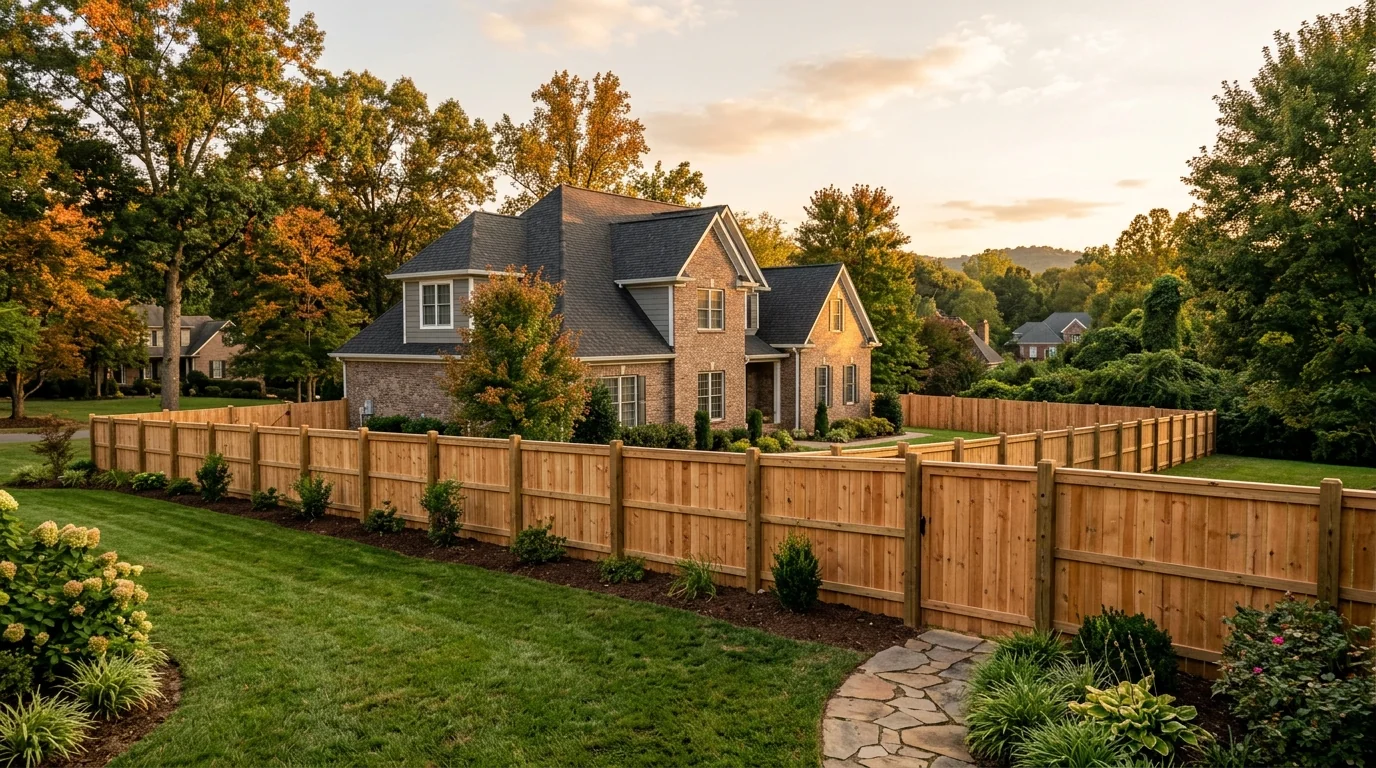
What to Expect During the Fence Installation Process
A residential fence installation in Knoxville, TN typically takes one to three days and follows six steps: site assessment and layout, utility marking, permit approval, post hole digging and setting, panel or rail installation, and final cleanup. Knowing each phase helps you ask the right questions, avoid surprises, and hold your installer accountable.
Updated Jul 10, 2025 · 8 min read
A residential fence installation in Knoxville follows six predictable steps: site layout and property-line confirmation, utility marking, permit approval where required, post hole digging and setting, panel or rail installation, and final cleanup. From the morning the crew arrives to the moment they leave, most jobs take one to three days. Knowing what happens at each step lets you prepare your yard, ask sharper questions during your quote, and catch any shortcuts before they become expensive problems.
Step 1. Site Assessment and Property-Line Confirmation
Before a single tool comes off the truck, the lead installer should walk the fence line with you. This walkthrough has one primary purpose: confirming where the fence will go before anything is dug.
Pull your property survey plat and walk the corners with the crew. Even experienced installers cannot read your survey for you. If you do not have a current plat, Knox County property records are searchable through the Knox County Property Assessor’s office. For any lot in question, hiring a licensed surveyor is the safest option. Building even a few inches onto a neighbor’s land can force a costly removal and re-installation.
Corner lots deserve extra attention. The City of Knoxville, the Town of Farragut, and unincorporated Knox County each have different front-yard and sight-triangle setback rules. If your lot sits near a jurisdictional boundary, confirm which rules apply before the crew marks the line.
Step 2. Call 811 Before Any Digging
Tennessee law requires a 811 call (the national “Call Before You Dig” service) at least three business days before any digging begins. Your installer should handle this as a standard part of their process. If they do not mention it, ask.
Utility locators will flag underground lines for gas, electric, water, and telecommunications with colored spray paint. This step costs nothing and prevents the kind of accident that stops a job entirely. In Knox County, where karst limestone geology can redirect buried utilities in unexpected paths, skipping this step carries real risk.
Step 3. Permits and HOA Approvals
The permit picture in Knoxville varies by exactly where your property sits:
- City of Knoxville. A permit is required for fences over six feet and for any fence in a historic or overlay district. Contact City of Knoxville Plans Review and Inspections.
- Town of Farragut. Farragut has notably stricter design-review standards that go beyond typical HOA rules. Many standard residential fences require approval. Contact Town of Farragut Community Development before signing any installation contract.
- Unincorporated Knox County. A permit is required for fences over six feet. Contact Knox County Codes Administration and Inspections.
Permit fees across these jurisdictions typically run $40 to $90. That is a small line item, but it matters: an uninspected fence can complicate a future home sale or require removal.
If your neighborhood sits in Farragut, Hardin Valley, Northshore/Choto, or select Karns and Powell subdivisions, you likely have HOA design covenants on top of local code. Most Knox County HOA covenants cap privacy fence height at six feet and restrict front-yard fencing. Get written HOA approval before the permit application, not after.
Pool barrier fencing must meet IRC requirements regardless of HOA rules: minimum 48 inches in height with a self-closing, self-latching gate (pool safety requirements from the U.S. Consumer Product Safety Commission).
Step 4. Post Hole Digging and Setting
This is the most physically demanding part of the job and the step that determines whether your fence stands straight a decade from now.
Hole depth
Most installers set posts 30 to 36 inches deep in Knox County’s moderate-to-high shrink-swell clay soils. The Valley and Ridge province soils here are residual clays weathered from limestone and dolomite (USDA Web Soil Survey, Knox County, Tennessee). Those soils expand when wet and contract when dry, cycling through the 47.9 inches of annual rainfall the area receives (NWS Morristown, KMRX, 1991-2020 Climate Normals). Posts that are too shallow will heave or lean within a few seasons.
Knoxville averages one to three tornado events per year (NWS Storm Prediction Center archive), which is low relative to other Southern metros. Wind load is a moderate concern rather than a primary design driver, but ice loading is a genuine winter hazard here. Ice accumulation adds significant weight to fence panels and to tree limbs hanging over the fence line. Deep, properly set posts handle both.
For lots on the rocky ridges of West Knox County, shallow bedrock may prevent a standard-depth hole. In those cases, a rock auger or surface-mount anchor system is the correct solution. Ask your installer how they handle bedrock before the crew arrives.
This Old House confirms that post holes should reach at least three feet deep to get below the frost line in similar climates, with the post set plumb in wet concrete and confirmed with a level (vinyl fence installation guide, This Old House).
Concrete curing
Most installers use fast-set concrete that reaches working strength in 20 to 40 minutes, but full cure takes 24 to 48 hours. A reputable crew will not hang panels on the same day as setting posts in wet concrete unless fast-set mix was used and adequate cure time has passed. If you see panels going on immediately after posts are dropped into wet concrete with no fast-set product, ask the crew to confirm their process.
Step 5. Panel, Rail, and Gate Installation
Once posts are set and cured, the crew installs rails and panels. For a wood privacy fence, this means attaching horizontal rails to the posts, then nailing or screwing individual pickets to those rails. For vinyl, pre-assembled panels slide into routed channels in the posts.
Gates require precise alignment. A gate that is hung even slightly off-plumb will sag over time and either drag on the ground or fail to latch. Watch that the installer checks the gate swing with a level and that the latch engages cleanly without forcing.
Pressure-treated Southern Yellow Pine is the standard residential material in Knoxville, and it is the right choice for Knox County’s wet-dry soil cycles. The wood will appear green-tinged when freshly installed. That color comes from the treatment chemical and fades to a natural wood tone as the lumber dries, typically over four to six weeks. If you plan to stain the fence, wait until the wood has fully dried before applying any product.
Aluminum ornamental fencing is common in West Knox HOA neighborhoods and lakefront communities along Northshore and Choto, where HOA design standards often require a more decorative profile. Vinyl is growing in popularity in newer West Knox subdivisions where low maintenance is a priority.
Step 6. Cleanup and Final Walkthrough
A professional installation crew leaves the yard in the same condition they found it. Concrete slurry, post hole spoil, packaging, and scrap material should all be removed. Run a final walkthrough using this checklist before you sign off:
- Check that every post is plumb by eye from a distance and, if in doubt, with a level.
- Walk the entire fence line looking for uneven panel heights, gaps at the bottom rail, or panels that bow outward.
- Open and close every gate. Each gate should swing freely, close on its own or with light pressure, and latch without lifting or forcing.
- Confirm post caps are in place on all exposed posts. Missing caps allow water to enter end grain and accelerate rot.
- Look for any concrete residue on panels or rails and ask the crew to clean it before they leave.
- Verify the fence does not cross onto neighboring property at any point.
Do not release final payment until you have completed this walkthrough.
What This Means for Your Knoxville Project
The installation process itself is straightforward when you know what each step is supposed to look like. The variables that create problems are almost always front-loaded: unclear property lines, missing permits, and installers who skip the utility call or cut post depth to save time.
Knoxville’s karst limestone soils and wet climate put more stress on fence posts than the national average. The difference between a fence that lasts eight years and one that lasts twenty often comes down to post depth, the quality of the concrete, and whether the wood was given time to cure before the first seasonal cycle.
For a breakdown of what materials and labor typically cost on a Knox County project, the fence cost guide on this site covers current price ranges by material. If you are comparing wood against vinyl for your specific situation, the fence installation service page covers both options in detail.
When you are ready to move from research to an actual quote, request a fence installation estimate here and have your property plat and HOA documents ready. The more information you bring to the first conversation, the more accurate the number you get back.
The average residential fence installation in Knoxville runs roughly 155 linear feet. According to Bob Vila, national averages for fence installation fall between $1,743 and $4,431 depending on material (Bob Vila fence installation cost guide). Knox County projects in the $1,900 to $5,800 range are typical once local labor rates, terrain adjustments, and permit costs are factored in. If a quote lands well below that floor, ask specifically how deep the posts will be set and what concrete mix the crew uses. Those two answers will tell you a great deal about the quality you are buying.
Free written quote
Planning a fence? Get a free quote.
On-site measure and a written quote within 24 hours. No obligation.
Questions
What to Expect During the Fence Installation Process FAQs
How long does fence installation take?
Do I need a permit to install a fence in Knoxville?
How deep should fence posts be set in Knox County soil?
What happens if my fence installer hits bedrock or a large root?
Should I mark my property lines before installation begins?
What should I do to prepare my yard before the crew shows up?
What does a finished fence installation look like at the end of the job?
Free quote
Talk to a Knoxville fencing pro
On-site measure and a written quote within 24 hours. No obligation.