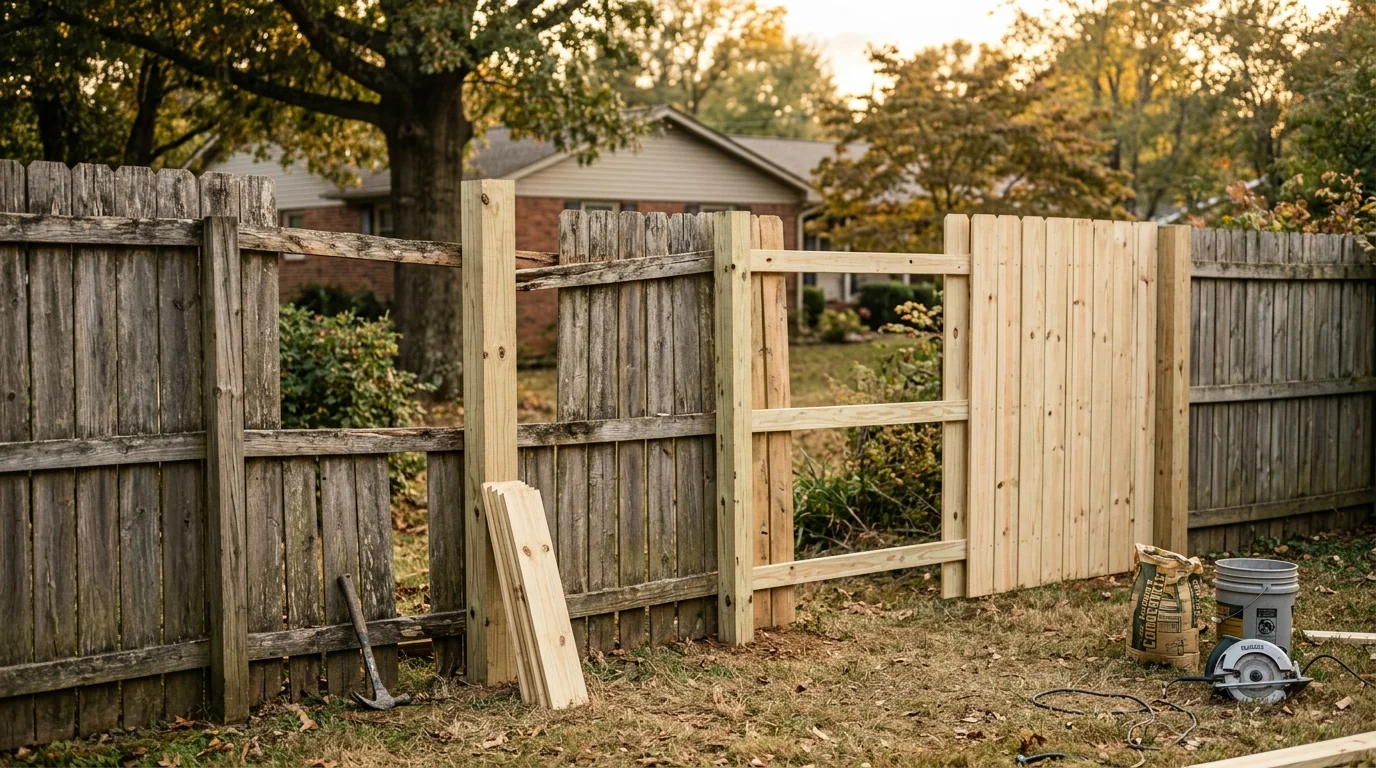
Fence Panel and Board Replacement in Knoxville, TN
A handful of rotted or cracked boards might look like a cosmetic annoyance, but fence panel replacement is one of the most time-sensitive repairs a Knoxville homeowner can make. Once moisture works its way past the surface of a board, it travels along the grain into rails and post connections, turning a simple swap into a much larger job. This page explains what damaged panels look like, why Knox County’s climate accelerates the problem, and which repair methods actually fix the underlying cause rather than just covering it up.
What This Symptom Looks Like (and When to Act)
What damaged fence panels look like exactly
The most visible signs are split or missing pickets, boards that bow outward away from the rails, and dark gray or black staining at the base of individual boards where they sit closest to grade. Press a screwdriver or nail firmly into any discolored wood. If it sinks more than a quarter inch with light pressure, the fiber is compromised. Soft spots at the top of a board, especially near nail holes, mean moisture has been pooling there. On vinyl fences, look for hairline cracks along panel edges or sections that no longer sit flush in the rail channel.
When to monitor versus act now
Monitor when damage is limited to surface checking or paint peeling on one or two boards with no soft spots underneath. That situation is real, but it is not urgent. Move to act-now when the horizontal rails feel soft at the post connection, when boards are pulling free of the rail entirely, or when a section is visibly leaning. Leaning panels almost always signal a compromised post rather than a panel issue alone. Check the fence post replacement and repair options page if the lean is more than a few degrees off plumb.
What NOT to do
Do not cover rotted boards with paint or wood filler expecting it to stop the decay. Sealing over rot traps moisture inside and feeds the very fungal process causing the breakdown. Avoid screwing new boards over old ones without removing the damaged material first. The hidden rot continues to spread into the rail behind the patch. Temporary fixes like zip ties, wire, or landscape staples that hold a broken panel upright are a hazard for children and pets and do nothing about structural loss.
What Causes It in Knoxville, TN
Knoxville’s climate is particularly hard on wood fencing. NWS Morristown (KMRX) records an average of 47.9 inches of rainfall per year across Knox County. That moisture load is constant, cycling through the limestone-derived clay and silty clay soils that dominate the Valley and Ridge province. These soils have moderate-to-high shrink-swell potential, meaning they expand when saturated and contract during dry stretches. That movement works against board-to-rail connections over time, opening small gaps that let water in at exactly the spots where rot starts.
Ground-contact board ends are the most vulnerable location in the Knoxville market. Standard fence builds leave a small gap between the bottom of the pickets and grade, but poor grading, mulch buildup, or heavy leaf accumulation from the area’s mature tree canopy frequently closes that gap. Once a board end touches consistently wet soil, decay sets in within a few seasons.
Ice loading is a secondary but meaningful factor specific to Knox County winters. Heavy ice accumulation on fence panels adds weight the horizontal rails were not designed to carry, bowing them outward and splitting board-to-rail connections. Sections with vine or plant growth are most vulnerable because vegetation traps ice and multiplies the load. The storm remnants of Hurricane Helene in September 2024 demonstrated how quickly Knox County’s saturated soils and wind loading can pull fence sections entirely free of their posts, with widespread board and panel failures reported across the metro.
West Knox County neighborhoods around Farragut, Hardin Valley, and Northshore tend to have newer fencing that is still within its useful life, but low-lying lots in those areas with poor drainage to nearby creeks or retention features see accelerated rot patterns. East and North Knoxville older neighborhoods frequently have wood fencing at or past the end of a typical 15-to-20-year service life for pressure-treated Southern Yellow Pine.
Repair Methods That Address It
Board-by-board picket replacement
For fences where the rails and posts are structurally sound, swapping individual rotted pickets is the most cost-effective first step. A contractor removes the failed boards, inspects the rail behind them, and installs matching pressure-treated pine or cedar pickets secured with exterior-rated screws rather than nails (screws resist withdrawal as wood cycles through wet and dry seasons). This approach works well when damage is scattered across a section rather than concentrated in one run.
Full panel section replacement
When a rail is soft or a post connection is weakened, replacing the entire panel section is more practical than piecing together individual boards. The framing comes out with the pickets, the post connections are inspected and reinforced if needed, and new pre-built panels or site-built sections go in. This is the standard repair for storm-damaged fencing and for sections where ice loading has bowed the rails past the point of usefulness. Learn more about what a full section repair involves on the fence repair services page.
Material upgrade to vinyl
Homeowners whose wood fence has reached or passed its service life often use a panel replacement project as the trigger to convert problem sections to vinyl. Vinyl does not rot, is unaffected by Knox County’s wet-dry soil cycles, and carries product warranties that wood cannot match. The per-linear-foot cost is higher upfront, but the long-term maintenance reduction is significant, particularly for busy families who do not want to budget for re-staining every few years. The vinyl fence installation page covers the full process and material options.
Staining and sealing as follow-up protection
Any wood panel repair should be followed by staining or sealing the repaired section, and ideally the full fence run, to slow future moisture infiltration. A penetrating oil-based stain applied to clean, dry wood closes the end grain at board tops and the exposed grain at cut edges, which are the two locations where moisture enters fastest. This step is not optional on a freshly repaired fence in Knox County’s rainfall environment. Read about the protective process on the fence staining and sealing services page.
Typical Cost Range
According to Bob Vila’s wood fence cost guide, privacy wood fence installation runs $27 to $60 per linear foot. Individual board replacement without rail work falls at the lower end of that range per affected section. Full panel section replacement with new framing approaches the mid-to-upper range depending on wood species, section height, and whether post connections need reinforcement.
For homeowners considering a material switch, Bob Vila’s vinyl fence cost guide puts vinyl fence material at $15 to $40 per linear foot, with full installed costs averaging $2,292 to $5,799 nationally. Knox County’s average fence project runs $1,900 to $5,800 for a typical 155-linear-foot installation, but panel replacement scopes are usually smaller and more targeted.
See the fence cost guide for a full breakdown of material and labor variables that affect your specific project.
Inspection Process
A free inspection for fence panel damage covers several specific checkpoints. The inspector probes each rail with a moisture meter or screwdriver to map where softness begins and ends, since visible board damage is often the tip of a larger rot pocket in the framing behind it. Post connections at every affected section get checked for lateral movement, because a post that rocks even slightly will re-stress new boards within a season or two.
The inspector also checks grade clearance along the full fence line. Boards sitting against or below finished grade are flagged for correction regardless of whether they show rot yet. Drainage patterns around the fence perimeter are noted, especially in low-lying Knox County lots where stormwater collects after heavy rain events.
For fences near Farragut or other HOA-governed communities, the inspection includes a quick review of covenant requirements for replacement material and color so the repair does not trigger an HOA violation.
Request your inspection through the free quote page to get a written scope before committing to any repair.
When to Skip Repair (or Wait)
Surface checking and graying of wood boards with no soft spots underneath is a cosmetic condition, not a structural one. Weathered gray wood that is still firm to the nail probe can be cleaned, brightened with a deck wash product, and stained without any board replacement. This situation warrants monitoring through one more winter, not an immediate repair call.
Similarly, a single cracked vinyl picket in an otherwise sound panel section is a low-priority repair if it does not compromise pet containment or privacy. Vinyl does not spread damage the way rot does in wood, so a cracked picket stays a cracked picket rather than undermining adjacent boards.
Wait on full-section replacement if a Knox County winter ice season is two to three weeks out. Fresh concrete at post connections needs adequate cure time before heavy loading, and scheduling post work just before a freeze can compromise the repair. Plan replacement projects for spring or early fall when ground temperatures and moisture conditions support proper curing.
If your fence is approaching 15 years of age and showing scattered damage in multiple sections, a full-replacement conversation often makes more economic sense than patching. The fence installation options page covers what a new installation scope looks like and how it compares to cumulative repair costs on aging fencing.