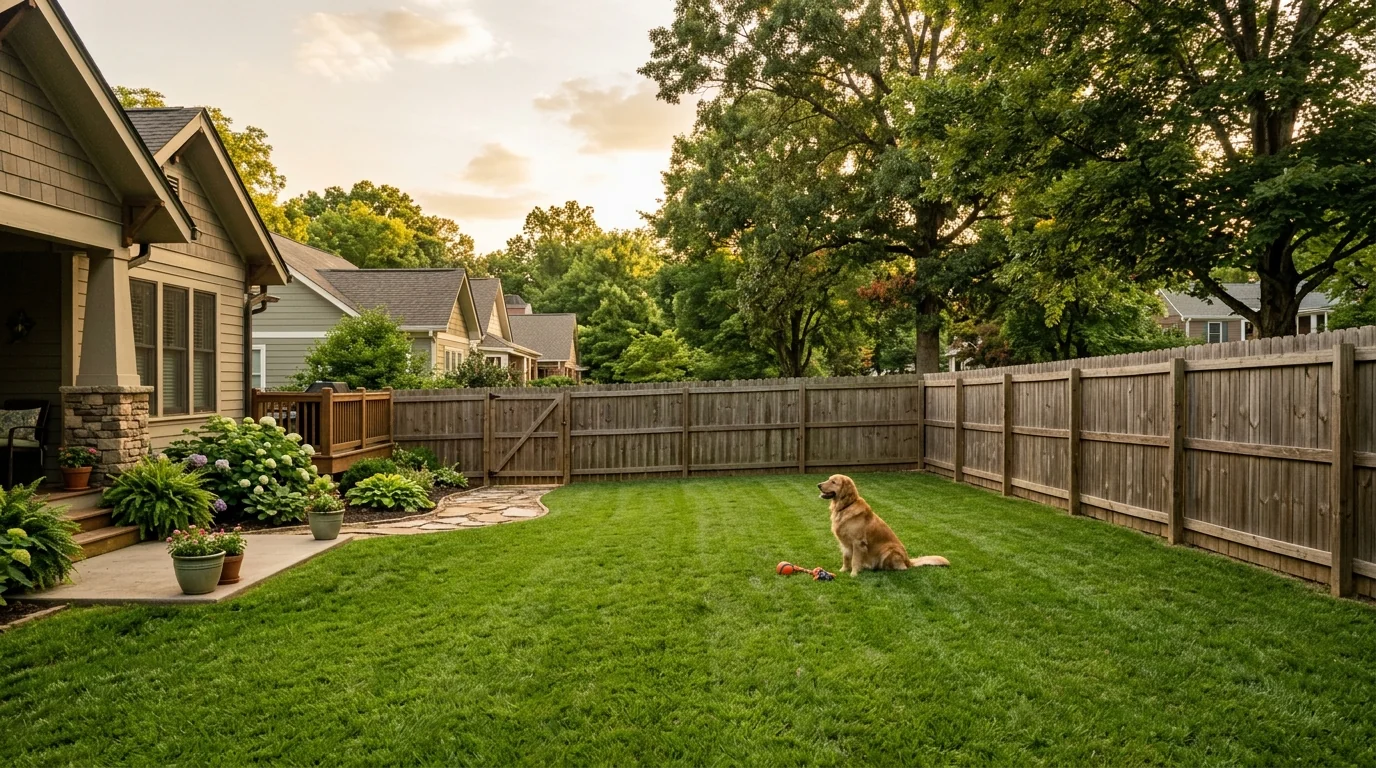
Best Fence for Dogs Height Material and Style Guide
The best fence for dogs combines a height of at least 5 to 6 feet, a solid or small-gap panel design, and a material durable enough to resist chewing and digging. In Knoxville, TN, pressure-treated wood and vinyl privacy fences are the most popular choices. The right pick depends on your dog's size, breed temperament, and your yard's terrain.
Updated Jul 11, 2025 · 7 min read
The Best Fence for Dogs
The best fence for dogs is a 6-foot solid privacy fence made from pressure-treated wood or vinyl. That height stops most large breeds from jumping, the solid panel design removes climbing footholds and eliminates the sight lines that trigger reactive barking, and both materials can be installed with buried footers or concrete bases that discourage diggers. For most Knoxville homeowners, those two materials cover 90 percent of dog-containment needs, though your dog’s specific breed and behavior may steer you toward one over the other.
Why Height Is the First Decision
Height determines whether your fence is actually a containment tool or just a yard decoration. A 4-foot fence is enough for small breeds with no jumping history. A 5-foot fence stops most medium dogs. For large breeds, athletic working dogs, and any dog known to test boundaries, 6 feet is the practical minimum.
Most Knox County HOA covenants cap residential privacy fences at 6 feet (a rule enforced particularly strictly in Farragut and Hardin Valley), so a 6-foot fence aligns with both containment needs and local code in nearly every Knoxville subdivision. Going taller is possible in some unincorporated Knox County lots, but check with Knox County Codes Administration before committing to anything over 6 feet.
One often-missed factor: height should be measured from the ground on the outside of the fence, the side your dog would land on if escaping. Sloped yards can create a 6-foot fence on the interior that reads as a 4-foot fence from outside on the downhill face. Ask your installer to account for grade changes when setting post heights.
Material Comparison: Wood vs Vinyl vs Chain-Link
Choosing the right material means weighing upfront cost, long-term maintenance, and how well each one holds up to a dog that digs, chews, or throws its weight against the panels.
| Material | Avg. Installed Cost per Linear Foot | Chew Resistance | Dig Resistance | Maintenance | Best For |
|---|---|---|---|---|---|
| Pressure-treated wood | $27 to $60 (Bob Vila) | Moderate | Low (needs footer) | Stain or seal every 2-3 years | Budget-conscious owners, classic look |
| Vinyl privacy | $25 to $40 (Bob Vila) | High | Low (needs footer) | Rinse with hose | Low-maintenance households |
| Chain-link (heavy gauge) | $15 to $30 (Bob Vila) | Low | Low (needs footer) | Minimal | Secondary dog runs, budget installs |
| Aluminum ornamental | $17 to $90 (Bob Vila) | High | Low (open bottom) | Minimal | Decorative yards, smaller calm dogs |
Pressure-treated Southern Yellow Pine is the dominant material in Knox County residential installs. It holds up to the region’s roughly 48 inches of annual rainfall (NWS Morristown KMRX, 1991-2020 Climate Normals) when properly sealed, and it pairs naturally with the architecture of older and mid-century Knoxville neighborhoods. The tradeoff is maintenance: without periodic staining or sealing, the wet-dry cycle that comes with Knoxville’s clay-heavy soils will cause boards to warp and split faster than in drier climates.
Vinyl has grown in popularity in newer West Knox subdivisions like Northshore and Hardin Valley, largely because it requires almost no upkeep beyond an occasional rinse. Dogs cannot stain it with muddy paws or wear it down the way they can softer wood. For households with large, high-energy breeds that lean on or paw at panels, vinyl’s rigidity and resistance to moisture make it a strong long-term choice.
Chain-link works for a dedicated dog run or a secondary yard area, but it has real containment problems for determined dogs. The diamond pattern is a ladder for climbers, lighter gauges can be chewed through by powerful breeds, and the open design means your dog sees everything outside the fence. That constant visual stimulation drives reactive barking. If you go with chain-link for budget reasons, choose a minimum 11-gauge wire and add a coyote roller or angled inward extension at the top.
For a deeper look at how wood and vinyl stack up across all use cases, see the wood vs vinyl fence comparison guide.
Style Details That Matter for Dogs
Material and height get most of the attention, but panel style and base design make or break real-world containment.
Board-on-board and shadowbox wood styles overlap boards to eliminate gaps while allowing airflow. These are good choices for reactive barkers because they break up sight lines without requiring a completely solid panel. Full privacy (flush boards, no gaps) is the maximum containment option and is better suited to dogs that lunge or push against the fence.
Post and rail with wire mesh is a common compromise for properties where neighbors prefer the look of a more open fence. A wood frame is built in a split-rail style and welded wire or hardware cloth is attached to the inside face. This keeps dogs in without blocking views, though it offers less chew resistance than solid panels.
Gate hardware is frequently overlooked. Self-latching gates are required for any fence adjacent to a pool under Knox County’s adoption of IRC pool barrier requirements (U.S. Consumer Product Safety Commission Publication 362), but they are also a best practice for any dog owner. A spring-loaded self-closing latch takes operator error out of the equation. Mount the latch on the pool side or inside face of the gate so dogs cannot nose it open.
Buried footers and base boards address digging. A horizontal concrete footer at the base of the fence line, or a pressure-treated kick board set 6 to 12 inches into the ground, physically blocks dogs from digging through. On Knox County’s clay soils, a concrete footer also adds post stability by resisting the seasonal shrink-swell movement that can loosen posts over time.
Local Knoxville Considerations
Knox County sits on the Valley and Ridge province, with primary soils derived from weathered limestone, dolomite, and shale. According to the USDA Web Soil Survey, these residual clays carry moderate-to-high shrink-swell potential. When posts are set at the standard 30 to 36 inch depth and properly backfilled, they hold well on most Knoxville lots. Ridge-position properties with shallow bedrock are the exception: those sites may require rock augering or a surface-mounted post anchor system, which changes the installation scope and cost.
Knoxville’s average 47.9 inches of annual rainfall (NWS Morristown) keeps wood fences under consistent moisture stress. Dog owners should factor fence staining into their maintenance budget from year one, not as an afterthought after boards begin to crack. A quality stain or sealant applied within the first year extends wood fence life significantly and reduces the chance of boards splitting in the wet-dry cycles that follow heavy rains.
West Knox neighborhoods have the highest HOA density in the metro. Farragut in particular enforces design standards that go beyond typical HOA rules, requiring specific materials, styles, and setbacks. Homeowners in Farragut, Hardin Valley, and Northshore should pull their HOA documents and confirm with the Town of Farragut Community Development office before ordering materials. A fence that is built outside those standards may have to come down at the owner’s expense, which erases any money saved by skipping the review process.
Ice loading is also worth mentioning. Knoxville sees periodic ice storms that add substantial weight to fence panels, especially when vegetation has grown into or along the fence line. Dogs that spend time outdoors in winter may push against panels that are already stressed by ice load. Keeping vegetation trimmed back from the fence reduces this risk.
Connecting This to Your Project
Once you know your dog’s behavior, your yard’s terrain, and your HOA’s rules, the material and height choices become straightforward. Most Knox County dog owners land on a 6-foot pressure-treated wood privacy fence with a concrete base board, a self-latching gate, and a stain applied at install. Vinyl is the better long-term choice for owners who want to skip maintenance entirely and can accommodate the slightly higher upfront cost.
For pricing details on both materials in the Knoxville market, the fence cost guide covers current per-linear-foot ranges and what drives costs up or down on typical lots. When you are ready to get a number specific to your yard, you can request a free fence installation estimate and have a local crew assess your terrain and layout in person.
If an existing fence is mostly intact but has a few damaged boards or a sagging gate, fence repair in Knoxville may be a more cost-effective path before committing to a full replacement. And if you want to review the full range of fencing options available for residential installation, the fence installation service overview is a good starting point.
Free written quote
Planning a fence? Get a free quote.
On-site measure and a written quote within 24 hours. No obligation.
Questions
Best Fence for Dogs Height Material and Style Guide FAQs
What height fence is best for dogs?
What is the best fence material to keep dogs in?
Can a dog dig under a vinyl or wood fence?
Is chain-link a good fence for dogs?
Do I need a permit to install a dog fence in Knoxville, TN?
What fence style keeps dogs from seeing through and barking at traffic?
How does Knoxville's clay soil affect dog fence installation?
Free quote
Talk to a Knoxville fencing pro
On-site measure and a written quote within 24 hours. No obligation.